A police car horn emits a sound at a frequency $240 Hz$ when the car is at rest. If the speed of the sound is $330 m/s$, the frequency heard by an observer who is approaching the car at a speed of $11 m/s,$ is ... $Hz$
Medium
Download our app for free and get started
(a) Frequency heard by the observer
$n' = n\,\left( {\frac{{v + {v_0}}}{v}} \right) = 240\,\left( {\frac{{330 + 11}}{{330}}} \right) = 248Hz.$
$n' = n\,\left( {\frac{{v + {v_0}}}{v}} \right) = 240\,\left( {\frac{{330 + 11}}{{330}}} \right) = 248Hz.$

Download our appand get started for free
Experience the future of education. Simply download our apps or reach out to us for more information. Let's shape the future of learning together!No signup needed.*
Similar Questions
- 1A stationary observer receives sound from two identical tuning forks, one of which approaches and the other one recedes with the same speed (much less than the speed of sound). The observer hears $2\; beats/sec$. The oscillation frequency of each tuning fork is $v_{0}=1400 \;\mathrm{Hz}$ and the velocity of sound in air is $350\; \mathrm{m} / \mathrm{s}$. The speed of each tuning fork is close toView Solution
- 2Equation of the progressive wave is given by : $y = a\sin \pi (40t - x)$ where $a$ and $x$ are in metre and $t$ in second. The velocity of the wave is ..... $m/s$View Solution
- 3A signal of $0.1\, kW$ is transmitted in a cable. The attenuation of cable is $-5 \,dB$ per $km$ and cable length is $20\, km$. The power received at receiver is $10^{-x} \, W$. The value of $x$ is ....... .View Solution
$\left[\right.$ Gain in $\left. dB =10 \log _{10}\left(\frac{ P _{0}}{ P _{i}}\right)\right]$
- 4A man is watching two trains, one leaving and the other coming in with equal speeds of $4\, m/sec$. If they sound their whistles, each of frequency $240 Hz$, the number of beats heard by the man (velocity of sound in air $= 320 m/sec$) will be equal toView Solution
- 5A transverse harmonic wave on a string is described by $y = 3 \sin \,(36t + 0.018x + \frac{\pi}{4})$ where $x$ and $y$ are in $cm$ and $t$ in $s$. The least distance between two sucessive crests in the wave is .... $m$View Solution
- 6View SolutionThe number of waves contained in unit length of the medium is called
- 7View SolutionThe sound carried by air from a sitar to a listener is a wave of the following type
- 8A pipe $30 cm$ long is open at both ends. Which harmonic mode of the pipe is resonantly excited by a $1.1 kHz$ source ? (Take speed of sound in air =$ 330 ms^{-1}$)View Solution
- 9A person is producing wave in string by moving his hand first up and then down. If frequency is $\frac{1}{8}\,Hz$ then find out time taken by particle which is at a distance of $9\,m$ from source to move to lower extreme first time .... $s$ . (Given $\lambda = 24\, m$)View Solution
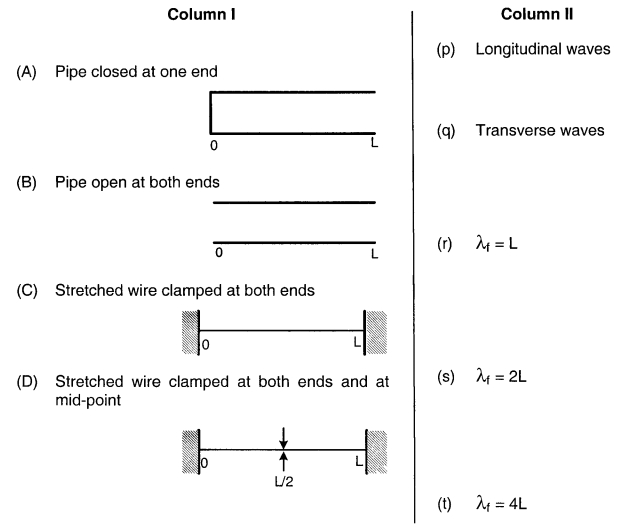
- 10Column $I$ shows four systems, each of the same length $L$, for producing standing waves. The lowest possible natural frequency of a system is called its fundamental frequency, whose wavelength is denoted as $\lambda_{ f }$. Match each system with statements given in Column $II$ describing the nature and wavelength of the standing waves.View Solution