MCQ
A policeman on duty detects a drop of $10 \%$ in the pitch of the hom of motion of car as it crosses him. If the velocity of sound is $330 \,m / s$. Calculate the speed of the car ........... $m / s$
- ✓$36.7$
- B$20.4$
- C$18.6$
- D$16.4$
drop q $10 \% \Rightarrow$ heard frequemy was $90 \%$ of original so if orisinal $=\nu$ then apparent $=0.9 \nu$ usins $\nu^{\prime}=\nu\left(\frac{v}{v+v s}\right) \quad$; vs $=\frac{\text { speed of }}{\text { car. }}$ put $\nu^{\prime}=0.9 v$
we qet $0.9=\frac{v}{v+u s} \Rightarrow 0.9 v+0.9 v s=v$
or $\quad 0.9 v_s=0.1 V \Rightarrow v_s=\frac{V}{9}$
put $v=330 \,m / s \quad U_s=\frac{330}{9}=36.7 \,m / s$
Generate a complete, print-ready paper with questions like this in minutes — across 16+ boards, with answer keys.
[Given: The speed of sound in air is $324 ms ^{-1}$ ]
($1$) When only $S_2$ is emitting sound and it is $Q$, the frequency of sound measured by the detector in $Hz$ is. . . . . .
($2$) Consider both sources emitting sound. When $S_2$ is at $R$ and $S_1$ approaches the detector with a speed $4 ms ^{-1}$, the beat frequency measured by the detector is $\qquad$ $Hz$.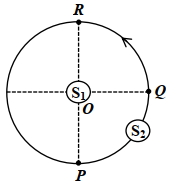
$STATEMENT-2$ By the principle of conservation of energy, the total kinetic energies of both the cylinders are identical when they reach the bottom of the incline.