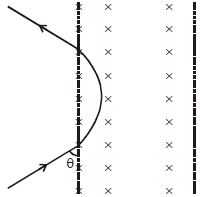
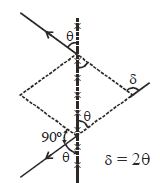
A positively charged particle enters in a region of uniform. Transverse magnetic field as shown in figure find net deviation in path of the particle.
Medium


Download our appand get started for free
Experience the future of education. Simply download our apps or reach out to us for more information. Let's shape the future of learning together!No signup needed.*
Similar Questions
- 1When a proton is released from rest in a room, it starts with an initial acceleration $a_0$ towards west. When it is projected towards north with a speed $v_0$ it moves with an initial acceleration $3a_0$ toward west. The electric and magnetic fields in the room areView Solution
- 2View SolutionA very high magnetic field is applied to a stationary charge. Then the charge experiences
- 3View SolutionThe magnetic induction at any point due to a long straight wire carrying a current is
- 4Assertion : A proton and an alpha particle having the same kinetic energy are moving in circular paths in a uniform magnetic field. The radii of their circular paths will be equal.View Solution
Reason : Any two charged particles having equal kinetic energies and entering a region of uniform magnetic field $\overrightarrow B $ in a direction perpendicular to $\overrightarrow B $, will describe circular trajectories of equal radii.
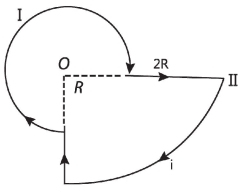
- 5Consider the circular loop having current $i$ and with central point $O$. The magnetic field at the central point $O$ isView Solution
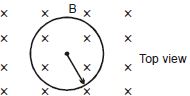
- 6A conducting circular loop of radius $r$ carries a constant current $i$. It is placed in a uniform magnetic field $\overrightarrow B $, such that $\overrightarrow B $ is perpendicular to the plane of the loop. The magnetic force acting on the loop isView Solution
- 7A non conducting ring (of mass $m,$ radius $r,$ having charge $Q$) is placed on a rough horizontal surface (in a region with transverse magnetic field). The field is increasing with time at the rate $R$ and coefficient of friction between the surface and the ring is $\mu .$ For ring to remain in equilibrium $\mu$ should be greater thanView Solution
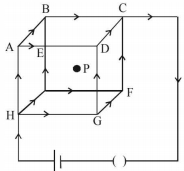
- 8A steady current is set up in a cubic network composed of wires of equal resistance and length $d$ as shown in figure. What is the magnetic field at the centre P due to the cubic networkView Solution
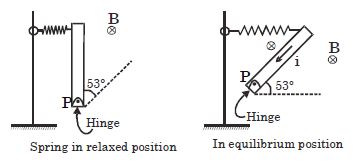
- 9A thin uniform rod with negligible mass and length $l$ is attached to the floor by a frictionless hinge at point $P$ . A horizontal spring with force constant $k$ connects the other end to wall. The rod is in a uniform magnetic field $B$ directed into the plane of paper. What is extension in spring in equilibrium when a current $i$ is passed through the rod in direction shown. Assuming spring to be in natural length initially.View Solution
- 10The resistance of a galvanometer is $50\, ohms$ and the current required to give full scale deflection is $100\,\mu A$. In order to convert it into an ammeter, reading upto $10\,A$, it is necessary to put a resistance ofView Solution