MCQ
A potentiometer wire is $100\,\, cm$ long and a constant potential difference is maintained across it. Two cells are connected in series first to support one another and then in opposite direction. The balance points are obtained at $50\,\, cm$ and $10\,\, cm$ from the positive end of the wire in the two cases. The ratio of emf's is 
  • A
    $5:4$
  • B
    $3:4$
  • $3:2$
  • D
    $5:1$

Answer

Correct option: C.
$3:2$
c
Suppose two cells have emfs $\varepsilon_{1}$ and $\varepsilon_{2}$

$\left(\text { also } \varepsilon_{1}>\varepsilon_{2}\right)$

Potential difference per unit length of the potentiometer wire $=k$ (say)

When $\varepsilon_{1}$ and $\varepsilon_{2}$ are in series and supporteach other then

$\varepsilon_{1}+\varepsilon_{2}=50\, \times k$       .....$(i)$

When $\varepsilon_{1}$ and $\varepsilon_{2}$ are in opposite direction

$\varepsilon_{1}-\varepsilon_{2}=10 \times k$     ....$(ii)$

On adding eqn. $(i)$ and eqn. $(ii)$

$2 \varepsilon_{1}=60\, k \Rightarrow \varepsilon_{1}=30 \,k$ and $\varepsilon_{2}=50\, k-30 \,k=20\, k$

$\therefore \quad \frac{\varepsilon_{1}}{\varepsilon_{2}}=\frac{30 \,k}{20 \,k}=\frac{3}{2}$

Need a full question paper?

Generate a complete, print-ready paper with questions like this in minutes — across 16+ boards, with answer keys.

Start Generating Free

Similar questions

A lift is coming from $8^{th}$ floor and is just about to reach $4^{th}$ floor. Taking ground floor as origin and positive direction upwards for all quantities, which one of the following is correct?
In an experiment the angles are required to be measured using an instrument, $29$ divisions of the main scale exactly coincide with the $30$ divisions of the vernier scale. If the smallest division of the main scale is half- a degree $(= 0.5^o  )$, then the least count of the instrument is
A body of mass $m$ moving with a constant velocity $v$ hits another body of the same mass moving with the same velocity $v$ but in the opposite direction and sticks to it. The velocity of the compound body after collision is
A small plane mirror placed at the centre of a spherical screen of radius $R$. A beam of light is falling on the mirror. If the mirror makes $n$ revolution. per second, the speed of light on the screen after reflection from the mirror will be
A nucleus of uranium decays at rest into nuclei of thorium and helium . Then 
The density of a solid metal sphere is determined by measuring its mass and its diameter. The maximum error in the density of the sphere is $\left(\frac{x}{100}\right) \% .$ If the relative errors in measuring the mass and the diameter are $6.0 \%$ and $1.5 \%$ respectively, the value of $x$ is
In extrinsic $P$ and $N-$type, semiconductor materials, the ratio of the impurity atoms to the pure semiconductor atoms is about
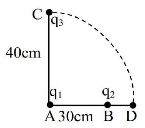
Two charges $q_{1}$ and $q_{2}$ are separated by a distance of 30 cm. A third charge $q_{3}$ initially at '$C$' as shown in the figure, is moved along the circular path of radius 40 cm from C to D. If the difference in potential energy due to movement of $q_{3}$ from $C$ to $D$ is given by $\frac{q_{3} K}{4 \pi \in_{0}}$, the value of $K$ is :
Image
One grams of $H_2$ at $27\,^oC$ is mixed with $16\, g$ of $O_2$ at $37\,^oC$. The temperature of the mixture is about ....... $^oC$
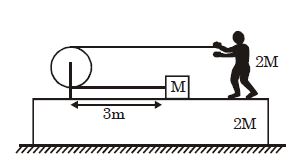
A block of mass $M$ is tied to one end of massless rope. The other end of rope is in the hands of a man of mass $2M$ as show in figure. Initially the block and the man are resting on a rough plank of mass $2M$ as shown in figure. The whole system is resting on a smooth horizontal surface. The man pulls the rope. Pulley is massless and frictionless. What is the magnitude of displacement of the plank when the block meets the pulley ......... $m $ (Man does not leave his position on the plank during the pull).