A potentiometer wire of length $100\, cm$ has a resistance of $10\, ohm.$ It is connected in series with a resistance and an accumulator of emf $2\,V$ and of negligible internal resistance. A source of emf $10\, mV$ is balanced against a length of $40\, cm$ of the potentiometer wire. What is the value of external resistance :- ................. $\Omega$
Medium


Download our appand get started for free
Experience the future of education. Simply download our apps or reach out to us for more information. Let's shape the future of learning together!No signup needed.*
Similar Questions
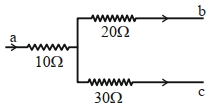
- 1Figure shows a part of an electric circuit. The potentials at points $a , b$ and $c$ are $30\,V , 12\,V$ and $2\,V$ respectively. The current through the $20 \Omega$ resistor will be $........\,A$View Solution
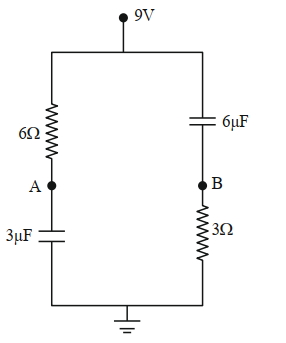
- 2In the given figure, the charge stored in $6 \ \mu \mathrm{F}$ capacitor, when points $A$ and $B$ are joined by a connecting wire is___________ $\mu \mathrm{C}$.View Solution
- 3In a Wheatstone’s bridge all the four arms have equal resistance $R$. If the resistance of the galvanometer arm is also $R$, the equivalent resistance of the combination as seen by the battery isView Solution
- 4The specific resistance of manganin is $50 \times {10^{ - 8}}\,ohm \times m$. The resistance of a cube of length $50\,cm$ will beView Solution
- 5Every atom makes one free electron in copper. If $1.1$ $ampere$ current is flowing in the wire of copper having $1\, mm$ diameter, then the drift velocity (approx.) will be (Density of copper $ = 9 \times {10^3}\,kg\,{m^{ - 3}}$ and atomic weight = $63$)View Solution
- 6In a metre-bridge when a resistance in the left gap is $2\ \Omega$ and unknown resistance in the right gap, the balance length is found to be $40\ \mathrm{~cm}$. On shunting the unknown resistance with $2\ \Omega$, the balance length changes by :View Solution
- 7By using only two resistance coils-singly, in series, or in parallel one should be able to obtain resistances of $3$, $4$, $12$ and $16\, ohms$. The separate resistances of the coil areView Solution
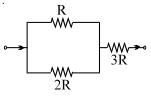
- 8The ratio of powers dissipatted respectively in $R$ and $3R$, as shown is:View Solution
- 9At room temperature, copper has free electron density of $8.4 \times {10^{28}}$ per ${m^3}$. The copper conductor has a cross-section of $10^{-6} \,m^2$ and carries a current of $5.4\, A$. The electron drift velocity in copper isView Solution
- 10The resistance of a wire is $R$. It is bent at the middle by $180^{\circ}$ and both the ends are twisted together to make a shorter wire. The resistance of the new wire isView Solution