A potentiometer wire of length $300\,cm$ is connected in series with a resistance $780\,\Omega$ and a standard cell of emf $4\,V$. A constant current flows through potentiometer wire. The length of the null point for cell of emf $20\,mV$ is found to be $60\,cm$. The resistance of the potentiometer wire is$...\Omega$
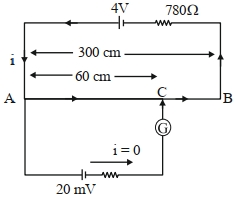
JEE MAIN 2022, Diffcult


Download our appand get started for free
Experience the future of education. Simply download our apps or reach out to us for more information. Let's shape the future of learning together!No signup needed.*
Similar Questions
- 1A metallic block has no potential difference applied across it, then the mean velocity of free electrons is $T$ = absolute temperature of the block)View Solution
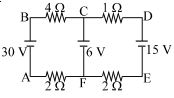
- 2View SolutionThe figure shows a network of four resistances and three batteries Choose the correct alternative
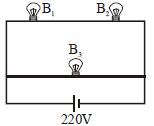
- 3A $100\, W \, bulb\, B_1$ and two $60\, W \,bulbs \,B_2$ and $B_3$, are connected to a $220\, V$ source, as shown in Figure. Now $P_1, P_2$ and $P_3$ are the output powers of the bulbs $B_1, B_2$ and $B_3$ respectively. ThenView Solution
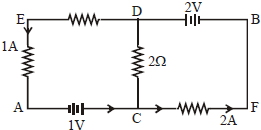
- 4In the circuit, given in the figure currents in different branches and value of one resistor are shown. Then potential at point $B$ with respect to the point $A$ is$.......V$View Solution
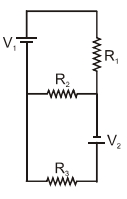
- 5Two ideal batteries of emf $V _1$ and $V _2$ and three resistances $R _1, R _2$ and $R _3$ are connected as shown in the figure.View Solution
The current in resistance $R _2$ would be zero if
$(A)$ $V_1=V_2$ and $R_1=R_2=R_3$
$(B)$ $V_1=V_2$ and $R_1=2 R_2=R_3$
$(C)$ $V_1=2 V_2$ and $2 R_1=2 R_2=R_3$
$(D)$ $2 V _1= V _2$ and $2 R _1= R _2= R _3$
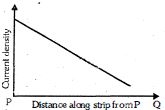
- 6An electric current flows along an insulated strip $PQ$ of a metallic conductor. The current density in the strip varies as shown in graph of figure. Which one of the following statements could explain this variation ?View Solution
- 7A potentiometer circuit has been set up for finding the internal resistance of a given cell. The main battery, used across the potentiometer wire, has an emf of $2.0\,V$ and a negligible internal resistance. The potentiometer wire itself is $4\,m$ long. When the resistance $R,$ connected across the given cell, has values of $(i)$ infinity $(ii)$ $9.5\,\Omega$ the balancing lengths on the potentiometer wire are found to be $3\,m$ and $2.85\,m,$ respectively. The value of internal resistance of the cell is ............... $\Omega$View Solution
- 8In the experiment of $Ohm's law,$ a potential difference of $5.0\, V$ is applied across the end of a conductor of length $10.0\, cm$ and diameter of $5.00\, mm .$ The measured current in the conductor is $2.00\, A$. The maximum permissible percentage error in the resistivity of the conductor isView Solution
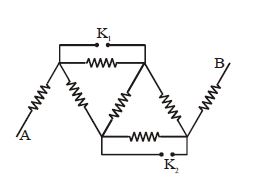
- 9All wires have same resistance and equivalent resistance between $A$ and $B$ is $R$. Now keys are closed, then the equivalent resistance will becomeView Solution
- 10When a current of $2\, A$ flows in a battery from negative to positive terminal, the potential difference across it is $12\, V$. If a current of $3\, A$ flows in the opposite direction potential difference across the terminals of the battery is $15\, V$, the $emf$ of the battery is ............... $\mathrm{V}$View Solution