MCQ
A primary amine can be converted to an alcohol by the action of
  • A
    Alkali
  • Nitrous acid
  • C
    Reducing agent
  • D
    Oxidising agent

Answer

Correct option: B.
Nitrous acid
b
(b)$R - N{H_2} + HN{O_2} \to \mathop {R - OH}\limits_{{\rm{alcohol}}} + {N_2} + {H_2}O$.

Need a full question paper?

Generate a complete, print-ready paper with questions like this in minutes — across 16+ boards, with answer keys.

Start Generating Free

Similar questions

Liquids $A$ and $B$ form an ideal solution. At $30\,^oC,$ the total vapour pressure of a solution containing $1\,mol$ of $A$ and $2\,mol$ of $B$ is $250\,\,mm\,Hg.$ The total vapour pressure becomes $300\,\,mm\,Hg$ when $1$ more mol of $A$ is added to the first solution. The vapour pressures of pure $A$ and $B$ at the same temperature are
Which one below is a pseudohalide
The charge (in coulomb) on $Cu ^{2+}$ ion is :
Which one of the following statements regarding helium is incorrect ?
Which of the following haloalkanes is most reactive
In the given table, identify the incorrect option. The digit in box indicate the moles  of that substance

Reactant

$HIO_4$

consumed

$HCO_2H$

formed

$HCHO$

formed

In quick vinegar process of acetic acid, the temperature of mixture is ......... $K$
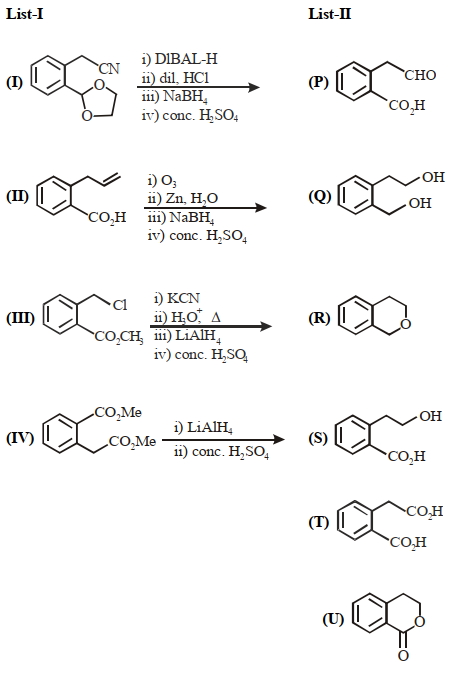
Answer the following by appropriately matching the lists based on the information given in the paragraph $List-I$ includess starting materials and reagents of selected chemical reactions. $List-II$ gives structures of compounds that may be formed as intermediate products and/or final products from the reactions of $List-I$

($1$) Which of the following options has correct combination considering $List-I$ and $List-II$?

$(1) (III), (S), (R)$ $(2) (IV), (Q), (R)$ $(3) (III), (T), (U)$ $(4) (IV), (Q), (U)$

($2$) Which of the following options has correct combination considering $List-I$ and $List-II$?

$(1) (I), (Q), (T), (U)$ $(2) (II), (P), (S), (U)$ $(3) (II), (P), (S), (T)$ $(4) (I), (S), (Q), (R)$

Give the answer quetion ($1$) and ($2$)
Which compound is not inflammable
Which of the following polymers are condensation polymers?
$a.$ Bakelite.
$b.$ Teflon.
$c.$ Butyl rubber.
$d.$ Melamine formaldehyde resin.