MCQ
A projectile fired with initial velocity $u$ at some angle $\theta $ has a range $R$. If the initial velocity be doubled at the same angle of projection, then the range will be
  • A
    $2R$
  • B
    $R/2$
  • C
    $R$
  • $4R$

Answer

Correct option: D.
$4R$
d
(d) $R = \frac{{{u^2}\sin 2\theta }}{g}$

$\therefore R \propto {u^2}$. If initial velocity be doubled then range will become four times.

Need a full question paper?

Generate a complete, print-ready paper with questions like this in minutes — across 16+ boards, with answer keys.
Start Generating Free

Similar questions

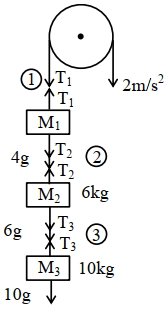
Three blocks $\mathrm{M}_1, \mathrm{M}_2, \mathrm{M}_3$ having masses $4 \mathrm{~kg}, 6 \mathrm{~kg}$ and $10 \mathrm{~kg}$ respectively are hanging from a smooth pully using rope 1,2 and 3 as shown in figure. The tension in the rope $1, \mathrm{~T}_1$ when they are moving upward with acceleration of $2 \mathrm{~ms}^{-2}$ is ............... $\mathrm{N}$ (if $\mathrm{g}=10 \mathrm{~m} / \mathrm{s}^2$ )
If the liquid neither rises nor falls in a capillary tube, then angle of contact is
The dimensions of Stefan-Boltzmann's constant $\sigma$ can be written in terms of Planck's constant $h$, Boltzmann's constant $k_B$ and the speed of light $c$ as $\sigma=h^\alpha k_B^\beta c^\gamma$. Here,
Two vectors $\overrightarrow{{X}}$ and $\overrightarrow{{Y}}$ have equal magnitude. The magnitude of $(\overrightarrow{{X}}-\overrightarrow{{Y}})$ is ${n}$ times the magnitude of $(\overrightarrow{{X}}+\overrightarrow{{Y}})$. The angle between $\overrightarrow{{X}}$ and $\overrightarrow{{Y}}$ is -
A car is travelling in the north direction. To stop, it produces a deceleration of $60\ m/ s^2$. Which of the following is a correct representation for the deceleration?
A particle, moving with uniform speed $v$, changes its direction by angle $\theta$ in time $t$. Magnitude of its average acceleration during this time is
If water rises in a capillary tube upto $3\, cm$. What is the diameter of capillary tube (Surface tension of water $= 7.2 ×10^{-2}\, N/m$)
A particle moves under the effect of a force $F = Cx$ from $x = 0$ to $x = {x_1}$. The work done in the process is
Which of the following is best close to an ideal black body
A $600\; kg$ rocket is set for a vertical firing. If the exhaust speed is $1000\; m / s$, the mass of the gas ejected per second (in $kg/sec$) to supply the thrust needed to overcome the weight of rocket is