MCQ
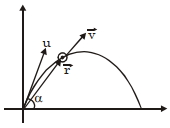
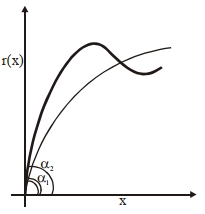
A projectile is launched from the origin in the $xy$ plane ( $x$ is the horizontal and $y$ is the vertically up direction) making an angle $\alpha$ from the $x$-axis. If its distance. $r =\sqrt{ x ^2+ y ^2}$ from the origin is plotted against $x$, the resulting curves show different behaviours for launch angles $\alpha_1$ and $\alpha_2$ as shown in the figure below. For $\alpha_1, r ( x )$ keeps increasing with $x$ while for $\alpha_2$, $r(x)$ increases and reaches a maximum, then decreases and goes through a minimum before increasing again. The switch between these two cases takes place at an angle $\alpha_c\left(\alpha_1 < \alpha_c < \alpha_2\right)$. The value of $\alpha_c$ is [ignore where $v_0$ is the initial speed of the projectile and $g$ is the acceleration due to gravity]
- A$\sin ^{-1}\left(\frac{1}{3}\right)$
- ✓$\cos ^{-1}\left(\frac{1}{3}\right)$
- C$\tan ^{-1}\left(\frac{1}{3}\right)$
- D$\tan ^{-1}(3)$