Question
A projectile is thrown with speed $40 \,ms ^{-1}$ at angle $\theta$ from horizontal. It is found that projectile is at same height at $1 \,s$ and $3 \,s$. What is the angle of projection?

Answer

(b)

$\tan \theta=\frac{v_y}{v_x}$

Also, $t_1+t_2=\frac{2 u \sin \theta}{g}$

$4=\frac{2 \times 40 \times \sin \theta}{10}$

$\sin \theta=\frac{1}{2} \Rightarrow \theta=30^{\circ}$

So, $\tan \theta=\tan 30^{\circ} \Rightarrow \frac{1}{\sqrt{3}}$

$\theta=\tan ^{-1}\left(\frac{1}{\sqrt{3}}\right)$

Need a full question paper?

Generate a complete, print-ready paper with questions like this in minutes — across 16+ boards, with answer keys.
Start Generating Free

Similar questions

Which of the following statements are true in case when two water drops collapse and make a bigger drop
A projectile is fired from level ground at an angle $\theta $ above the horizontal. The elevation angle $\phi $ of the highest point as seen from the launch point is related to $\theta $ by the relation
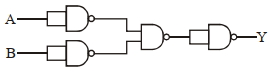
The following logic gate is equivalent to
If frequency of electromagnetic wave is $60 \mathrm{MHz}$ and it travels in air along $\mathrm{z}$ direction then the corresponding electric and magnetic field vectors will be mutually perpendicular to each other and the wavelength of the wave (in $\mathrm{m}$ ) is :
A resistor and an pure inductor are connected to an ac supply of $120\,V$ and $50\,Hz$. The current in the circuit is $3\,A$. If the power consumed in the circuit is $108\,W$, then the resistance in the circuit is.....$\Omega $
Inside a hollow charged spherical conductor, the potential
Two soap bubbles of radii $2 \,cm$ and $4 \,cm$ join to form a double bubble in air, then radius of curvature of interface is .......... $cm$
Consider a carnot's cycle operating between $T_1 = 500\,K$ and $T_2 = 300\,K$ producing $1\,kJ$ of mechanical work per cycle. Find the heat transferred to the engine by the reservoirs  .... $J$
In a photoelectric experiment for $4000\, Å$ incident radiation, the potential difference to stop the ejection is $2 V$. If the incident light is changed to $3000\, Å$, then the potential required to stop the ejection of electrons will be
A reflecting telescope utilizes