MCQ
A proton, a deuteron and an α particle are accelerated through same potential difference and then they enter in a normal uniform magnetic field, the ratio of their kinetic energies will be:
- A2 : 1 : 3
- B1 : 1 : 2
- C1 : 1 : 1
- D1 : 2 : 4
Explanation:
Kinetic energy obtained = qV where q is the charge and V is the potential through which the particle is accelerated.
Also, the force due to the magnetic field is perpendicular to the direction of motion.
So it cant change the speed and consequentially Kinetic energy of the particles will remain same after they enter a normal magnetic field.
In the above problem, V is constant.
So $\text{KE}\propto\text{q}.$
The charges of the proton, deuteron and the alpha particle are in the ratio 1 : 1 : 2
So, their kinetic energies are in the ratio 1 : 1 : 2
Generate a complete, print-ready paper with questions like this in minutes — across 16+ boards, with answer keys.
The output current versus time curve of a rectifier is shown in the figure. The average value of the output current in this case is

|
(a) 0 |
(b) i0/p |
(c) 2i0/p |
(d) i0 |
A beam of ions with velocity 2  enters normally into a uniform magnetic field of 4
 If the specific charge of the ion is 5
  , then the radius of the circular path described will be
|
(a) 0.10 m |
(b) 0.16 m |
(c) 0.20 m |
(d) 0.25 m |
A radioactive substance emits
|
(a) Electromagnetic radiation |
(b) Electrons revolving around the nucleus |
|
(c) Charged particles |
(d) a,c |
For uranium nucleus how does its mass vary with volume
|
(a) m ∝ V |
(b) m ∝ 1/V |
(c) m ∝ |
(d) m ∝ |
What is the net force on the square coil
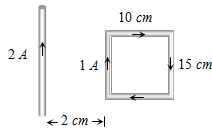
|
(a) 25 |
(b) 25 |
|
(c) 35 |
(d) 35 |


