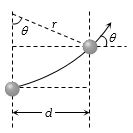
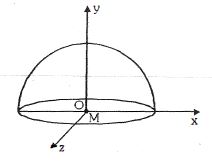
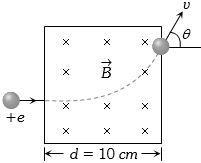
A proton accelerated by a potential difference $500\;KV$ moves though a transverse magnetic field of $0.51\;T$ as shown in figure. The angle $\theta $through which the proton deviates from the initial direction of its motion is......$^o$
Experience the future of education. Simply download our apps or reach out to us for more information. Let's shape the future of learning together!No signup needed.*
Two parallel long current carrying wire separated by a distance $2 \mathrm{r}$ are shown in the figure. The ratio of magnetic field at $\mathrm{A}$ to the magnetic field produced at $C$ is $\frac{x}{7}$. The value of $x$ is $\qquad$
The radius of a circular current carrying coil is $R$. At what distance from the centre of the coil on its axis, the intensity of magnetic field will be $\frac{1}{2 \sqrt{2}}$ times that at the centre?
Two straight parallel wires, both carrying $10$ $ampere$ in the same direction attract each other with a force of $1 \times {10^{ - 3}}\,N$. If both currents are doubled, the force of attraction will be
A charge moving with velocity $v$ in $X$-direction is subjected to a field of magnetic induction in the negative $X$-direction. As a result, the charge will
Three long straight wires are connected parallel to each other across a battery of negligible internal resistance. The ratio of their resistances are $3 : 4 : 5$. What is the ratio of distances of middle wire from the others if the net force experienced by it is zero
A non conducting ring (of mass $m,$ radius $r,$ having charge $Q$) is placed on a rough horizontal surface (in a region with transverse magnetic field). The field is increasing with time at the rate $R$ and coefficient of friction between the surface and the ring is $\mu .$ For ring to remain in equilibrium $\mu$ should be greater than