Question
A proton and a deuteron are accelerated through the same accelerating potential. Which one of the two has,
  1. greater value of de-Broglie wavelength associated with it, and
  2. less momentum?
Give reasons to justify your answer.

Answer

  1. de Broglie wavelength is given by

$\lambda = \frac{\text{h}}{\sqrt{2\text{mqV}}}$

As mass of proton < mass of deuteron and qp = qd and v is same

$\Rightarrow\lambda_{p} > \lambda_{d}$ for same accelerating potential.

  1. Momentum $ = \frac{\text{h}}{\lambda}$

$\because\lambda_{p}> \lambda_{d}$

 $\therefore$ momentum o proton will be less, than that of deuteron.

Need a full question paper?

Generate a complete, print-ready paper with questions like this in minutes — across 16+ boards, with answer keys.

Start Generating Free

Similar questions

From the formula of potential energy of a system of two charges, obtain the equation of P.E. of electric dipole in external electric field.
The height of mercury column in a barometer in a Calcutta laboratory was recorded to be 75cm. Calculate this pressure in SI and CGS units using the following data: Specific gravity of mercury = 13.6, Density of water = 103kg/m3, g = 9.8m/s2 at Calcutta. Pressure = $\text{h}\rho\text{g}$ in usual symbols.
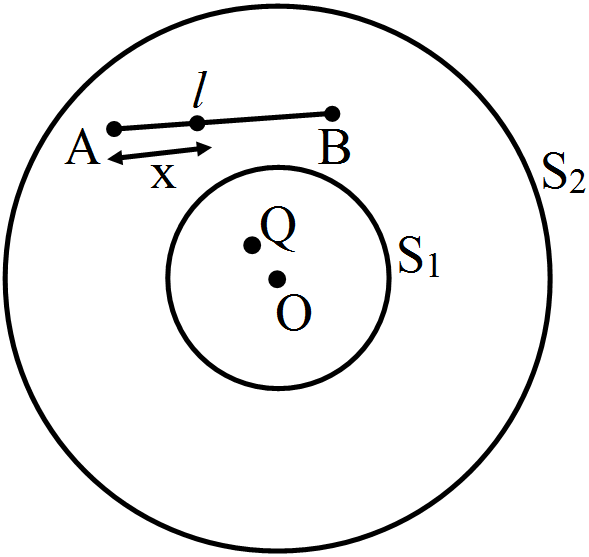
In the figure shown, calculate the total flux of the electrostatic field through the spheres S1 and S2. The wire AB shown here has a linear charge density $\lambda$ given by $\lambda=\text{kx}$ where x is distance measured along the wire, from the end A.

An $\alpha$–particle and a proton are moving in the plane of paper in a region where there is a uniform magnetic field directed normal to the plane of the paper. If the particles have equal linear momenta, what would be the ratio of the radii of their trajectories in the field?
Find the dimensions of:

  1. Electric field E,
  2. Magnetic field B and
  3. Magnetic permeability $\mu_0.$
The relevant equations are

$\text{F = qE, F = qvB,}$ and $\text{B}=\frac{\mu_0\text{I}}{2\pi\alpha};$

where F is force, q is charge, v is speed, I is current, and a is distance.

If $\overrightarrow{\text{A}}\times\overrightarrow{\text{B}}=0,$ can you say that:

  1. $\overrightarrow{\text{A}}=\overrightarrow{\text{B}}$

  2. $\overrightarrow{\text{A}}\neq\overrightarrow{\text{B}}$

Write a short note on Gamma rays.
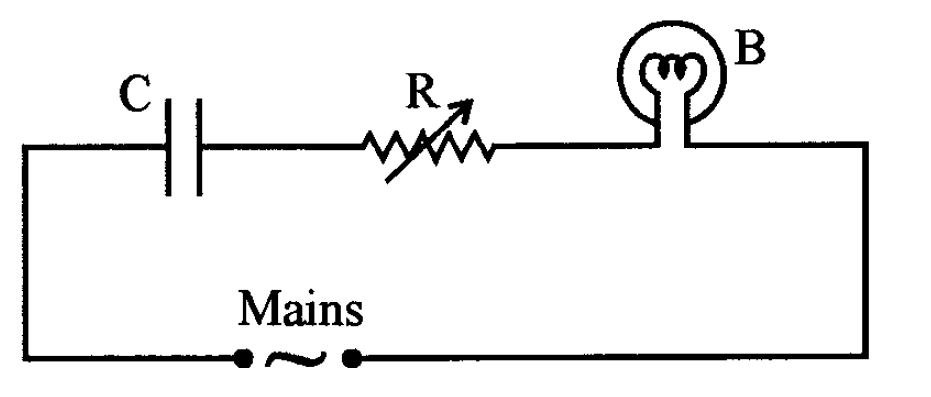
A capacitor'C', a variable resistor 'R' and a bulb oB' are connected in series to the ac mains in circuit as shown. The bulb glows with some brightness. How will the glow of the bulb change if (i) a dielectric slab is introduced between the plates of the capacitor, keeping resistance R to be the same; (ii) the resistance R is increased keeping the same capacitance?


The equation of refraction at a spherical surface is $\frac{\mu_2}{\text{v}}-\frac{\mu_1}{\text{u}}-=\frac{\mu_2-\mu_1}{\text{R}}.$ Taking $\text{R}=\infty,$ show that this equation leads to the equation $\frac{\text{Real depth}}{\text{Apparent depth}}=\frac{\mu_2}{\mu_1}$ for refraction at a plane surface.