Question

A proton and a deutron both having the same kinetic energy, enter perpendicularly into a uniform magnetic field B. For motion of proton and deutron on circular path of radius   and   respectively, the correct statement is

(a)  

(b)  

(c)  

(d)  

Answer

(a)  

Need a full question paper?

Generate a complete, print-ready paper with questions like this in minutes — across 16+ boards, with answer keys.

Start Generating Free

Similar questions

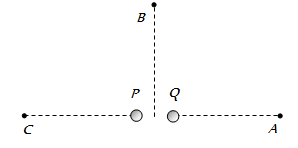
Figure here shows P and Q as two equally intense coherent sources emitting radiations of wavelength 20 m. The separation PQ is 5.0 m and phase of P is ahead of the phase of Q by 90o. A, B and C are three distant points of observation equidistant from the mid-point of PQ. The intensity of radiations at A, B, C will bear the ratio

(a) 0 : 1 : 4

(b) 4 : 1 : 0

(c) 0 : 1 : 2

(d) 2 : 1 : 0

The amount of force exerted on a unit positive charge in an electric field is known as _____?

From the graph between current I and voltage V shown below, identify the portion corresponding to negative resistance

(a) AB

(b) BC

(c) CD

(d) DE

A current carrying power line carries current from west to east. Then the direction of the magnetic field 2m above it is:

Two plane mirrors are at right angles to each other. A man stands between them and combs his hair with his right hand. In how many of the images will he be seen using his right hand

(a) None   

(b) 1

(c) 2  

(d) 3

Which of the following graphs shows the variation of magnetic induction B with distance r from a long wire carrying current

(a)

(b)

(c)

(d)

A man can see only between 75 cm and 200 cm. The power of lens to correct the near point will be

(a) + 8/3 D

(b)  + 3 D

(c) – 3 D  

(d)  – 8/3 D

A uniform wire of resistance $50\Omega$ is cut into 5 equal parts. These parts are now connected in parallel. The equivalent resistance of the combination is:
  1. $2\Omega$
  2. $10\Omega$
  3. $250\Omega$
  4. $6250\Omega$
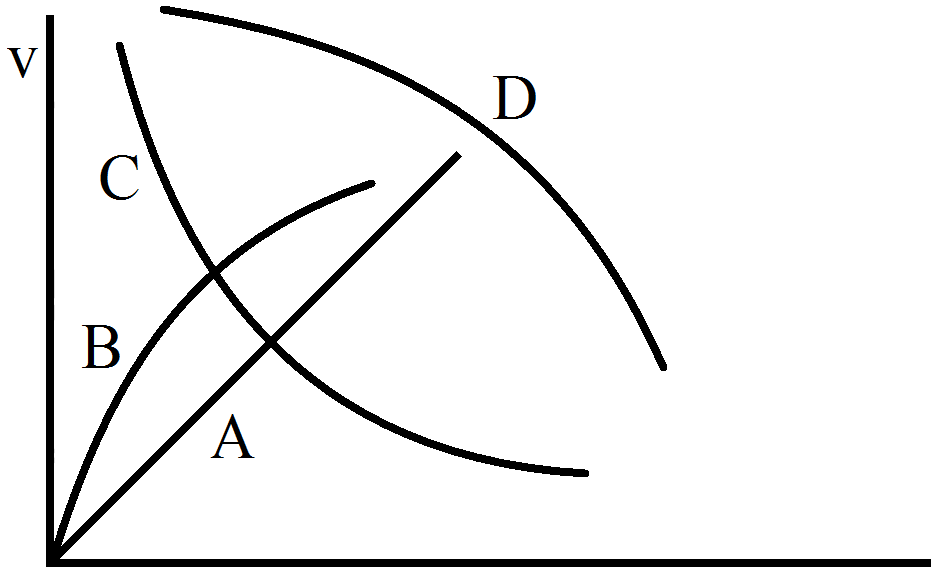
A spherical ball is dropped in a long column of a viscous liquid. The speed of the ball as a function of time may be best represented by the graph:
  1. A
  2. B
  3. C
  4. D

The light reflected by a plane mirror may form a real image

(a) If the rays incident on the mirror are diverging

(b) If the rays incident on the mirror are converging

(c) If the object is placed very close to the mirror

(d) Under no circumstances