MCQ
$A$ proton and an $\alpha$-particle are accelerated through a potential difference of $100 V$. The ratio of the wavelength associated with the proton to that associated with an $\alpha$-particle is
  • A
    $\sqrt 2 :1$
  • B
    $2:1$
  • $2\sqrt 2 :1$
  • D
    $\frac{1}{{2\sqrt 2 }}:1$

Answer

Correct option: C.
$2\sqrt 2 :1$
c
(c) $\lambda = \frac{h}{{\sqrt {2mQV} }} $

$\Rightarrow \lambda \propto \frac{1}{{\sqrt {mQ} }}$

$ \Rightarrow \frac{{{\lambda _p}}}{{{\lambda _\alpha }}} = \sqrt {\frac{{{m_\alpha }{Q_\alpha }}}{{{m_p}{Q_p}}}} $

$ = \sqrt {\frac{{4{m_p} \times 2{Q_p}}}{{{m_p} \times {Q_p}}}} = 2\sqrt 2 $

Need a full question paper?

Generate a complete, print-ready paper with questions like this in minutes — across 16+ boards, with answer keys.

Start Generating Free

Similar questions

A pendulum with time period of $1\, s$ is losing energy due to damping. At certain time its energy is $45\, J$. If after  completing $15\,oscillations$ , its energy has become $15\, J$, its damping constant (in $s^{-1}$ ) is
A biconvex lens forms a real image of an object placed perpendicular to its principal axis. Suppose the radii of curvature of the lens tend to infinity. Then the image would
Which of the following rays has the maximum frequency
Assertion : In Young’s double slit experiment if wavelength of incident monochromatic light is just doubled, number of bright fringe on the screen will increase.

Reason : Maximum number of bright fringe on the screen is directly proportional to the wavelength of light used.

A block slides down an inclined plane of slope of angle $\theta $ with a constant velocity. It is then projected up the plane with an initial velocity $u$. The distance upto which it will rise before coming to rest is
A curved in a level road has a radius $75\, m$. The maximum speed of a car turning this curved road can be $30 \,m / s$ without skidding. If radius of curved road is changed to $48\, m$ and the coefficient of friction between the tyres and the road remains same, then maximum allowed speed would be .........$m / s$.
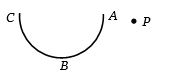
In the following diagram the work done in moving a point charge from point $P$ to point $A$, $B$ and $C$ is respectively as $W_A$, $W_B$ and $W_C$ , then
A radioactive nucleus undergoes a series of decay according to the scheme

$A\xrightarrow{\alpha }{{A}_{1}}\xrightarrow{\beta }{{A}_{2}}\xrightarrow{\alpha }{{A}_{3}}\xrightarrow{\gamma }{{A}_{4}}$

If the mass number and atomic number of $A$ are $180$ and $72$ respectively, then what are these number for $A_4$

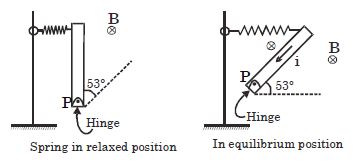
A thin uniform rod with negligible mass and length $l$ is attached to the floor by a frictionless hinge at point $P$ . A horizontal spring with force constant $k$ connects the other end to wall. The rod is in a uniform magnetic field $B$ directed into the plane of paper. What is extension in spring in equilibrium when a current $i$ is passed through the rod in direction shown. Assuming spring to be in natural length initially.
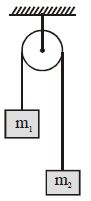
Two masses $m_1 = 3\,kg$ and $m_2 = 7\,kg$ tied to a string are hanging over a light frictionless pulley. What is the acceleration of the masses when system is free to move ? $[g = 10\,m/s^2]$  ...... $m/s^2$