Question
A proton and an electron are accelerated by same potential difference have de-Broglie wavelength $\lambda_p$ and $\lambda_e$.
$\lambda=\frac{h}{\sqrt{2 m e V}}$
So it is clear that de Broglie wavelength is inversely proportional to the square root of the mass of the material. Now mass of electron is less that the mass of the proton so de Broglie wavelength of electron will be greater than that of proton. So,
the answer is option $(C).$
Generate a complete, print-ready paper with questions like this in minutes — across 16+ boards, with answer keys.
$(1)$ $\rightarrow$ If $d = 7\lambda /2, O$ will be a minima
$(2)$ $\rightarrow$ If $d = 4.3\lambda$ , there will be a total of $8$ minima on $y$ axis.
$(3)$ $\rightarrow$ If $d = 7\lambda , O$ will be a maxima.
$(4)$ $\rightarrow$ If $d = \lambda$ , there will be only one maxima on the screen.
Which is the set of correct statement :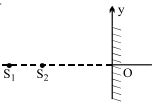
$(A)$ If the wind blows from the observer to the source, $f_2 > f_1$.
$(B)$ If the wind blows from the source to the observer, $f_2 > f_1$.
$(C)$ If the wind blows from the observer to the source, $f _2 < f _1$.
$(D)$ If the wind blows from the source to the observer, $f _2 < f _1$.