Question
A proton exerts a force on a proton which is:
  1. Gravitational.
  2. Electromagnetic.
  3. Nuclear.
  4. Weak.

Answer

  1. Gravitational
  2. Electromagnetic
  3. Nuclear

Explanation:

A proton exerts gravitational, electromagnetic and nuclear forces on a proton.

The gravitational force can easily be seen everywhere; it the weakest among all the forces. It is negligible in elementary particles like protons.

The electromagnetic force can be seen between charged particles. Since proton is a charged particle, it can exert this force on other protons.

The nuclear force is present only if the interacting particles are protons or neutrons or both. So, this force can exist between two protons.

Need a full question paper?

Generate a complete, print-ready paper with questions like this in minutes — across 16+ boards, with answer keys.

Start Generating Free

Similar questions

In an experiment to measure the speed of sound by a resonating air column, a tuning fork of frequency $500 Hz$ is used. The length of the air column is varied by changing the level of water in the resonance tube. Two successive resonances are heard at air columns of length $50.7 cm$ and $83.9 cm$. Which of the following statements is (are) true?

$(A)$ The speed of sound determined from this experiment is $332 m s ^{-1}$

$(B)$ The end correction in this experiment is $0.9 cm$

$(C)$ The wavelength of the sound wave is $66.4 cm$

$(D)$ The resonance at $50.7 cm$ corresponds to the fundamental harmonic
A ball of mass $0.5 \mathrm{~kg}$ is attached to a string of length $50 \mathrm{~cm}$. The ball is rotated on a horizontal circular path about its vertical axis. The maximum tension that the string can bear is $400 \mathrm{~N}$. The maximum possible value of angular velocity of the ball in rad/s is,:
Which of the following vehicles is undergoing a deacceleration?
Density of ice is $\rho $ and that of water is $\sigma $. What will be the decrease in volume when a mass $M$  of ice melts
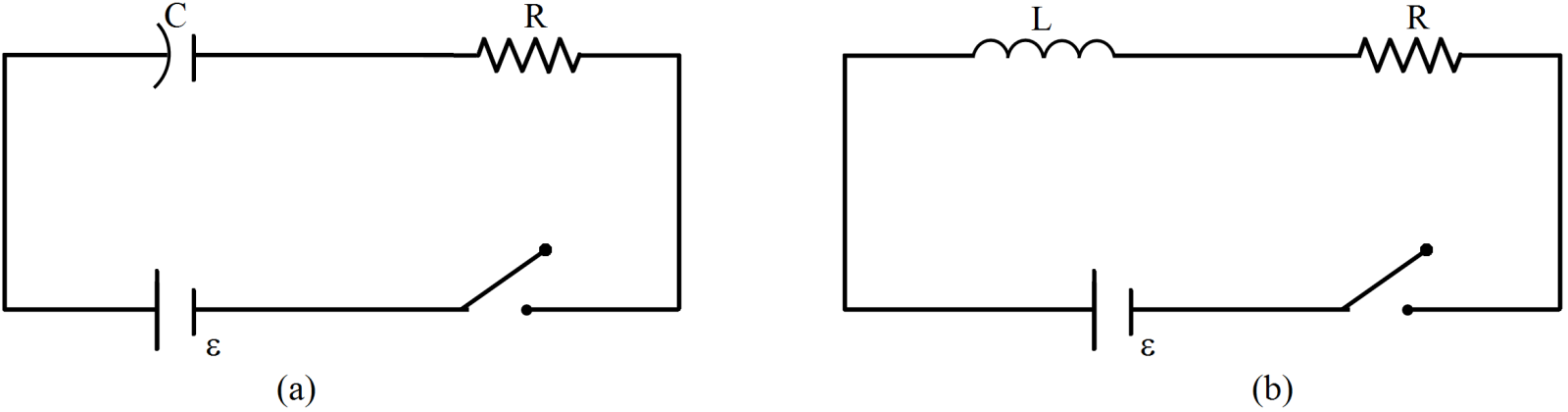
The switches in figure are closed at t = 0 and reopened after a long time at t = t0:

  1. The charge on C just after t = 0 is $\in\text{C}.$
  2. The charge on C long after t = 0 is $\in\text{C}.$
  3. The current in L just before t = tis $\frac{\in}{\text{R}}.$
  4. The current in L long after t = t0 is $\frac{\in}{\text{R}}.$
The coefficient of performance of a Carnot refrigerator working between ${30^o}C$ and ${0^o}C$ is
Two particles undergo $SHM$ along parallel lines with the same time period $(T)$ and equal amplitudes. At a particular instant, one particle is at its extreme position while the other is at its mean position. They move in the same direction. They will cross each other after a further time
A gas is enclosed in a closed pot. On keeping this pot in a train moving with high speed, the temperature of the gas
For n-particles in a space, the suitable expression for the position vector of centre of mass is:
A pulley of rad ius $2\ m$ is rotated about its axis by a force $ F = (20t -5t^2)$  newton (where tis measured in seconds) applied tangentially. If the moment ofinertia of the pulley about its axis ofrotation is $10\ kg-m^2$ the number ofrotations made by the pulley before its d irection of motion is reversed , is