Question

A proton is about 1840 times heavier than an electron. When it is accelerated by a potential difference of 1 kV, its kinetic energy will be

(a) 1840 keV

(b) 1/1840 keV

(c) 1 keV

(d) 920 keV

Answer

(c) 1 keV

Need a full question paper?

Generate a complete, print-ready paper with questions like this in minutes — across 16+ boards, with answer keys.

Start Generating Free

Similar questions

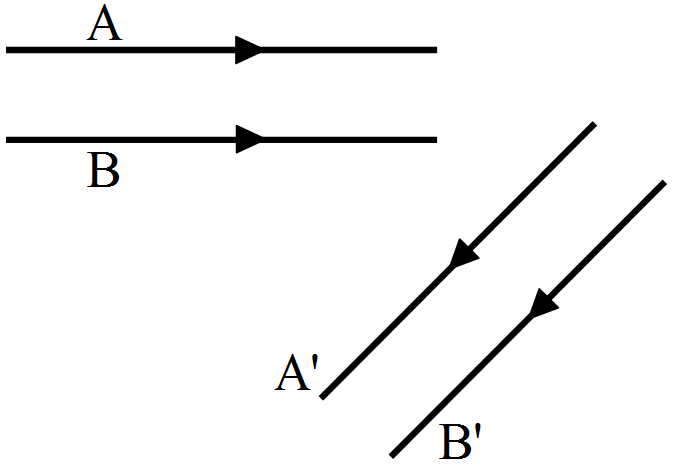
Two rays A and B being reflected by a mirror and going as A' and B'. The mirror:

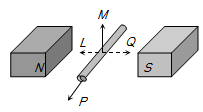
An electric potential difference will be induced between the ends of the conductor shown in the diagram, when the conductor moves in the direction

(a)  P

(b) Q

(c)  L 

(d) M

In double slits experiment, for light of which colour the fringe width will be minimum

(a) Violet  

(b) Red

(c) Green  

(d) Yellow

For which of the following colour, the magnifying power of a microscope will be maximum

(a) White colour 

(b)  Red colour 

(c) Violet colour 

(d)  Yellow colour 

The induced emf produced when a magnet is inserted into a coil does not depend upon:
If heat is supplied to an ideal gas in an isothermal process:
  1. The internal energy of the gas will increase.
  2. The gas will do positive work.
  3. The gas will do negative work.
  4. The said process is not possible.
Two wires of same size whose resistivities$\rho_1$ are $\rho_2$ and are joined in series. The equivalent resistivity of the combination will be:

Assertion   :  In a simple battery circuit the point of lowest potential is positive terminal of the battery

Reason      : The current flows towards the point of the higher potential as it flows in such a circuit from the negative to the positive terminal.

(a) If both assertion and reason are true and the reason is the correct explanation of the assertion.

(b) If both assertion and reason are true but reason is not the correct explanation of the assertion.

(c) If assertion is true but reason is false.

(d) If the assertion and reason both are false.

A metal rod moves at a constant velocity in a direction perpendicular to its length. A constant uniform magnetic field exists in space in a direction perpendicular to the rod as well its velocity. Select correct statements (s) from the following.

Radio waves and visible light in vacuum have

(a) Same velocity but different wavelength

(b) Continuous emission spectrum

(c) Band absorption spectrum 

(d) Line emission spectrum