MCQ
A proton is accelerated through $225 \,V$. Its de Broglie wavelength is ........ $nm$
  • A
    $0.1$
  • $0.2$
  • C
    $0.3$
  • D
    $0.4$

Answer

Correct option: B.
$0.2$
b
(b)

Energy it gains $=225 \,eV$

$\lambda=\frac{h}{m v}=\frac{\lambda h}{\sqrt{2 m E}}$

Need a full question paper?

Generate a complete, print-ready paper with questions like this in minutes — across 16+ boards, with answer keys.
Start Generating Free

Similar questions

Two identical capacitors have same capacitance $C$. One of them is charged to the potential $\mathrm{V}$ and other to the potential $2 \mathrm{~V}$. The negative ends of both are connected together. When the positive ends are also joined together, the decrease in energy of the combined system is :
Different voltages are applied across a P-N junction and the currents are measured for each value. Which of the following graphs is obtained between voltage and current 
In a series circuit $R = 300\,  \Omega$, $L = 0.9$ $ H, C = 2.0\, \mu$$F$ and $\omega$= $1000 \,rad/sec$. The impedance of the circuit is........$\Omega$
A particle, of mass $10^{-3} kg$ and charge $1.0 C$, is initially at rest. At time $t =0$, the particle comes under the influence of an electric field $\dot{E}( t )= E _0 \sin \omega t \hat{ i }$, where $E _0=1.0 N C ^{-1}$ and $\omega=10^3 rad s ^{-1}$. Consider the effect of only the electrical force on the particle. Then the maximum speed, in $m s ^{-1}$, attained by the particle at subsequent times is. . . . . .
The output of a $NAND$ gate is $0$
According to Einstein’s photoelectric equation, the plot of the kinetic energy of the emitted photo electrons from a metal Vs the frequency of the incident radiation gives as straight the whose slope?
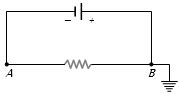
A battery is connected to a uniform resistance wire $AB$ and $B$ is earthed. Which one of the graphs below shows how the current density $J$ varies along $AB$
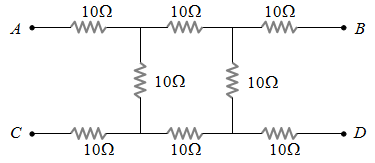
What will be the equivalent resistance between the two points A and D

The sensitivity of a tangent galvanometer is increased if
A symmetric double convex lens is cut in two equal parts by a plane containing the principal axis. If the power of the original lens was $4D$, the power of a divided lens will be: