Question
A pulse travelling on a string is represented by the function:

$\text{y}=\frac{\text{a}^3}{(\text{x}-\text{vt})^2+\text{a}^2},$

where a = 5mm and v = 20cm/s. Sketch the shape of the string at t = 0, 1s and 2s.Take x = 0 in the middle of the string.
Answer

The pulse is given by, $ \text{y}=\Bigg[\frac{(\text{a}^3)}{\big\{(\text{x}-\text{vt})^2+\text{a}^2\big\}}\Bigg]$
a = 5mm = 0.5cm, v = 20cm/s
At t = 0s, $\text{y}=\frac{\text{a}^3}{(\text{x}^2+\text{a}^2)}$
The graph between y and x can be plotted by taking different values of x.
(left as exercise for the student)
Similarly, at t = 1s, $\text{y}=\frac{\text{a}^3}{\big\{(\text{x}-\text{v})^2+\text{a}^2\big\}}$
and at t = 2s, $\text{y}=\frac{\text{a}^3}{\big\{(\text{x}-2\text{v})^2+\text{a}^2\big\}}$

Need a full question paper?

Generate a complete, print-ready paper with questions like this in minutes — across 16+ boards, with answer keys.

Start Generating Free

Similar questions

For which value of displacement are the potential and kinetic energies equal in value in simple harmonic motion?
A cylinder of diameter exactly 1cm at 30°C is to be slid into a hole in a steel plate. The hole has a diameter of 0.99970cm at 30°C. To what temperature must the plate be heated? For steel $\alpha-1.1\times10^{-5}(^\circ\text{C}^{-1}).$
A person is painting his house walls. He stands on a ladder with a bucket containing paint in one hand and a brush in other. Suddenly the bucket slips from his hand and falls down on the floor. If the bucket with the paint had a mass of 6.0kg and was at a height of 2.0m at the time it slipped, how much gravitational potential energy is lost together with the paint?
How does the elasticity of material change on:
  1. Increasing the temperature.
  2. On heating and cooling gradually.
  3. On hammering.
Find the minimum and maximum wavelengths of sound in water that is in the audible range (20-20000Hz) for an average human ear. Speed of sound in water = 1450m/s.
The decay constant of $\text{ }^{197}_{80}\text{Hg}$ (electron capture to $\text{ }^{197}_{79}\text{Au}$) is 1.8 × 10⁻⁴ S-1.
  1. What is the half-life?
  2. What is the average-life?
  3. How much time will it take to convert 25% of this isotope of mercury into gold?
Two stars radiate maximum energy at wavelength 3.6 × 10-7 m and 4.8 × 10⁻⁷m respectively. What is the ratio of their surface temperature.
How can you find the mass of earth, starting from the law of gravitation?
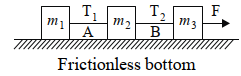
In the figure, three blocks are tied with two strings $A$ and $B . m_1=10 kg, m_2=5 kg, m_3=5 kg$. The bottom is frictionless. If $m _3$ is pulled to the right by applying a horizontal force of 50 N then calculate the tension in the strings.
Image
Find the dimensions of:

  1. The specific heat capacity c.
  2. The coefficient of linear expansion a.
  3. The gas constant R.
Some of the equations involving these quantities are

$\text{Q = mc(T}_2-\text{T}_1),\text{l}_{\text{t}}=\text{l}_0[1+\alpha(\text{T}_2-\text{T}_1)]$ and $\text{PV = nRT}.$