MCQ
A quantity of heat required to change the unit mass of a solid substance, from solid state to liquid state, while the temperature remains constant, is known as
  • A
    Latent heat
  • B
    Sublimation
  • C
    Hoar frost
  • Latent heat of fusion

Answer

Correct option: D.
Latent heat of fusion
d
(d) A quantity of heat required to change the unit mass of a solid substance, from solid state to liquid state, while the temperature remains constant, is known as latent heat of fusion.

Need a full question paper?

Generate a complete, print-ready paper with questions like this in minutes — across 16+ boards, with answer keys.

Start Generating Free

Similar questions

The heat radiated per unit area in $1\,hour$ by a furnace whose temperature is $3000\,K$ is $( \sigma  = 5. 7 \times 10^{-8}\,W\,m^{-2}\,K^{-4})$
If satellite is shifted towards the earth. Then time period of satellite will be
A resonating air column shows resonance with a tuning fork of frequency $256\, Hz$ at column lengths $33.4\, cm$ and $101.8\, cm$. The speed of sound in air is ...... $ms^{-1}$
The circular scale of a micrometer has $200$ divisions and pitch of $2\,mm$ . Find the measured value of thickness of a thin sheet .......... $mm$
The excess pressure due to surface tension in a spherical liquid drop of radius r is directly proportional to
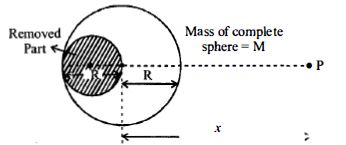
The gravitational field, due to the 'left over part' of a uniform sphere (from which a part as shown, has been 'removed out'), at a very far off point , $P$, located as shown, would be (nearly)
Two vectors $\overrightarrow a $ and $\overrightarrow b $ are at an angle of $60^o$ with  each other. Their resultant makes an angle of $45^o$ with $\overrightarrow a $ . If $|\overrightarrow b | = 2\,units$ then $|\overrightarrow a |$ is:-
A body starts from rest and moves with uniform acceleration for $3\ s.$ It then decelerates uniformly for $2\ s.$ and stops. If the deceleration is $3 \ ms^{-2}$ the maximum velocity of the body is$. . . ms^{-1}$
If $P = \frac{{{A^3}}}{{{B^{5/2}}}}$ and $\Delta A$ is absolute error in $A$ and $\Delta B$ is absolute error in $B$ then absolute error $\Delta P$ in $P$ is
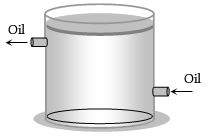
The top of insulated cylindrical container is covered by a disc having emissivity $0.6$ and thickness $1\, cm$. The temperature is maintained by circulating oil as shown in figure. If temperature of upper surface of disc is $127^o C$ and temperature of surrounding is $27^o C$, then the radiation loss to the surroundings will be (Take $\sigma = \frac{{17}}{3} \times {10^{ - 8}}W/{m^2}{K^4})$