Question
A radioactive isotope is being produced at a constant rate $\frac{\text{dN}}{\text{dt}}=\text{R}$ in an experiment. The isotope has a half-life $\text{t}_{\frac{1}2{}}.$ Show that after a time $\text{t}>>\text{t}_{\frac{1}{2}},$ the number of active nuclei will become constant. Find the value of this constant.
Answer

Given: Half life period $=\text{t}_{\frac{1}{2}}$
Rate of radio active decay $=\frac{\text{dN}}{\text{dt}}=\text{R}\Rightarrow\text{R}=\frac{\text{dN}}{\text{dt}}$
Given after time $\text{t}>>\text{t}_{\frac{1}{2}},$ the number of active nuclei will become constant.
i.e. $\Big(\frac{\text{dN}}{\text{dt}}\Big)_{\text{present}}=\text{R}=\Big(\frac{\text{dN}}{\text{dt}}\Big)_{\text{decay}}$
$\therefore\text{R}=\Big(\frac{\text{dn}}{\text{dt}}\Big)_{\text{decay}}$
$\Rightarrow\text{R}=\lambda\text{N}$ [where, $\lambda$ = Radioactive decay constant, N = constant number]
$\Rightarrow\text{R}=\frac{0.693}{\text{t}_{\frac{1}{2}}}(\text{N})\Rightarrow\text{Rt}_{\frac{1}{2}}=0.693\text{N}\Rightarrow\text{N}=\frac{\text{Rt}_{\frac{1}{2}}}{0.693}$

Need a full question paper?

Generate a complete, print-ready paper with questions like this in minutes — across 16+ boards, with answer keys.

Start Generating Free

Similar questions

A hydrogen atom emits ultraviolet radiation of wavelength 102.5nm. What are the quantum numbers of the states involved in the transition?
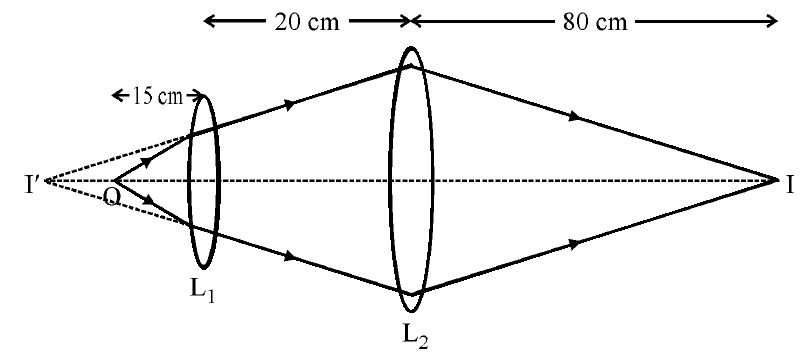
In the following diagram, an object ‘O’ is placed 15 cm in front of a convex lens $L_1$ of focal length 20 cm and the final image is formed at ‘I’ at a distance of 80 cm from the second lens $L_2.$ Find the focal length of the lens $L_2.$​​​​​​​
Double - convex lenses are to be manufactured from a glass of refractive index 1.55, with both faces of the same radius of curvature. What is the radius of curvature required if the focal length is to be 20cm?
Find the time required for a 50Hz alternating current to change its value from zero to the rms value.
Two identical capacitors of 12 pF each are connected in series across a battery of 50 V. How much electrostatic energy is stored in the combination? If these were connected in parallel across the same battery, how much energy will be stored in the combination now?
Also find the charge drawn from the battery in each case.
Radiation from hydrogen discharge tube falls on a cesium plate. Find the maximum possible kinetic energy of the photoelectrons. Work function of cesium is 1.9eV.
A series LCR circuit is connected across an a.c. source of variable angular frequency $' \omega'$. Plot a graph showing variation of current ‘i’ as a function of $' \omega'$ for two resistances $R_1$ and $R2 (R_1 > R_2).$
Answer the following questions using this graph:
  1. In which case is the resonance sharper and why?
  2. In which case is the power dissipation more and why?
In the Bohr model of hydrogen atom, the electron is treated as a particle going in a circle with the centre at the proton. The proton it self is assumed to be fixed in an inertial frame. The centripetal force is provided by the Coloumb attraction. In the ground state, the electron goes round the proton in a circle of radius $5.3 \times 10^{-11}m.$ Find the speed of the electron in the ground state. Mass of the electron $= 9.1 \times 10^{-31}kg$ and charge of the electron $= 1.6 \times 10^{-19}C.$
A plate of area $10cm^2$​​​​​​​ is to be electroplated with copper (density $9000kg/m^3$) to a thickness of 10 micrometres on both sides, using a cell of 12V. Calculate the energy spent by the cell in the process of deposition. If this energy is used to heat 100g of water, calculate the rise in the temperature of the water. ECE of copper $= 3 \times 10^{-7}kg C^{-1}$ and specific heat capacity of water $= 4200Jkg^{-1}.$
Iron emits $\text{K}_\alpha$ X-ray of energy 6.4keV and calcium emits $\text{K}_\alpha$ X-rays of energy 3.69 keV. Calculate the times taken by an iron $\text{K}_\alpha$ photon to cross through a distance of 3km.