Question
A radioactive nucleus ${ }_{\mathrm{Z}}^{\mathrm{A}} \mathrm{X}$ first emits a beta particle and then an alpha particle to give the resulting nucleus ${ }_Q^P Y$ What will be the values of $P$ and $Q$ in terms of $A$ and $Z$ ?

Answer

Initially element is represented by ${ }_z x^A$
$\beta$ particle is represented by $-1 e^{\circ}$ after emitting a $\beta$ particle atomic number of element would increase by 1 unit and mass number of element would remain unchanged.
So after emitting a $\beta$ particle ${ }_z x^A$ would become ${ }_{z+1} x^A$
a particle is rep resented by ${ }_2 He ^4$ this means it contains 2 protons and 2 neutrons so mass of a particle is 4 unit. Thus after emitting a particle mass number of element would decrease by $4$ unit and atomic number of element would decrease by  $2.$
So after emitting a particle $_zX^A$ would become $_{z+1-2}X^{A-4} = _{z-1}X^{A-4}.$
The daughter nucleus is represented by $_QY^P.$​​​​​​​
$_Qy^P =_{z-1}X^{A-4.}$
$P= A-4.$
$Q= Z-1.$

Need a full question paper?

Generate a complete, print-ready paper with questions like this in minutes — across 16+ boards, with answer keys.
Start Generating Free

Similar questions

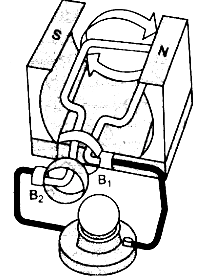
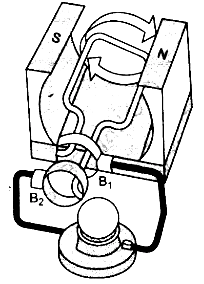
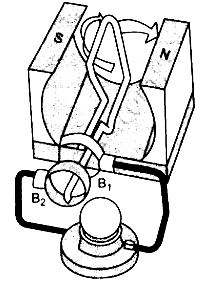
The given figures $1$ to $3$ show the working of a simple $A.C$. generator. Study the diagrams and answers of the following questions.


(i) State and explain the principle underlying the working of a simple generator.
(ii) Where is the loop of wire placed?
(iii) What happens when the loop is rotated?
(iv) Indicate the direction of the current flow through the wire for the first half of the turn (in first figure). Name and state the rule used in finding the direction of the current.
(v) Indicate the direction of the current for the case shown in second figure.
(vi) Indicate the direction of current in the outer circuit (i.e., electric bulb) in first and third figure.
(vii) What type of current is shown in the above diagrams? Explain.
Define the terms principal foci and focal lengths as applied to a convex lens, and show them with the help of proper diagrams.
Distinguish between $\alpha , \beta$ and $γ$ rays.
A machine is driven by a $50$ kg mass falling at a rate of $10.0$ m in $5 s$ . It lifts n load of 250 kgf . Taking the force of gravity on 1 kg mass as 10 N . Calculate the power input to the machine. If the efficiency of the machine is $60 \%$, find the height to which the load is raised in $5 s $.
What is the wavelength of the wave whose frequency is $10^{12} Hz?$ Name the electromagnetic wave.
List any six forms of energy and write a short note on each of them.
How will you verify the laws of refraction or how the refractive index of glass is determined in the laboratory?
How much heat energy is released when 5.0 of water at $20^{\circ} C$ changes into ice at $0^{\circ} C$ ? Take
specific heat capacity of water $=4.2 Jkg ^{-1} K ^{-1}$, Specific latent heat of fusion of ice $336 Jg ^{-1}$
A cell supplies a current of $0.6 A$ through a $2Ω$ coil and a current of $0.3$ A through on $8Ω $ coil. Calculate the e.m.f and internal resistance of the cell.
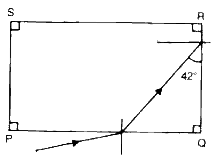
(a) A ray of monochromatic light enters glass $PQRS$ as shown in the fig. Complete the path of ray till it emerges from the glass. (Critical angle of glass is $42^0).$

(b) Draw diagram of a prism periscope.
(c) What are the advantages of total internal reflecting prism over plane mirror?