Question

A radioactive sample at any instant has its disintegration rate 5000 disintegration per minute. After 5 minutes, the rate is 1250 disintegrations per minute. Then, the decay constant (per minute) is

(a) 0.8 In 2

(b) 0.4 In 2

(c) 0.2 In 2

(d) 0.1 In 2

Answer

(b) 0.4 In 2

Need a full question paper?

Generate a complete, print-ready paper with questions like this in minutes — across 16+ boards, with answer keys.

Start Generating Free

Similar questions

To convert a moving coil galvanometer into voltmeter
The electric field at a point on equatorial line of a dipole and direction of the dipole moment:

A charged particle is moving with velocity v in a magnetic field of induction B. The force on the particle will be maximum when

(a) v and B are in the same direction

(b) v and B are in opposite directions

(c) v and B are perpendicular

(d) v and B are at an angle of 45°

If two lenses of +5 diopters are mounted at some distance apart, the equivalent power will always be negative if the distance is

(a) Greater than 40 cm

(b) Equal to 40 cm

(c) Equal to 10 cm

(d) Less than 10 cm

The maximum focal length of the eye-lens of a person is greater than its distance from the retina. The eye is:

Huygens principle of secondary waves:

A simple pendulum of period T has a metal bob which is negatively charged. If it is allowed to oscillate above a positively charged metal plate, its period will

(a) Remains equal to T

(b) Less than T

(c) Greater than T

(d) Infinite

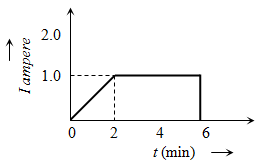
In a copper voltameter, mass deposited in 6 minutes is m gram. If the current-time graph for the voltameter is as shown here, then the E.C.E of the copper is

(a) m / 5  

(b) m / 300

(c) 5 m    

(d) m / 18000

Two wires of resistance R1 and R2 have temperature coefficient of resistance  and , respectively.  These are joined in series.  The effective temperature coefficient of resistance is

(a)

(b)

(c)

(d)