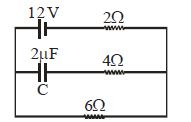
A railway compartment is lit up by thirteen lamps each taking $2.1\, amp$ at $15\, volts$. The heat generated per second in each lamp will be ............ $cal$
Easy
Download our app for free and get started
(c) The heat generated $= IVt$ $ = 2.1 \times 15 \times 1 = 31.5\,J$
$ = 31.5/4.2\,\,cal$$ = 7.5\,cal.$
$ = 31.5/4.2\,\,cal$$ = 7.5\,cal.$

Download our appand get started for free
Experience the future of education. Simply download our apps or reach out to us for more information. Let's shape the future of learning together!No signup needed.*
Similar Questions
- 1In an electric circuit, a cell of certain emf provides a potential difference of $1.25\, {V}$ across a load resistance of $5\, \Omega .$ However, it provides a potential difference of $1\, {V}$ across a load resistance of $2\, \Omega$. The $emf$ of the cell is given by $\frac{x}{10} v$. Then the value of $x$ is ..... .View Solution
- 2The combination of two identical cells, whether connected in series or parallel combination provides the same current through an external resistance of $2 \,\Omega$. The value of internal resistance of each cell is ............ $\Omega$View Solution
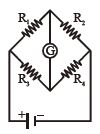
- 3The resistances in $WSB$ circuit shown in the diagram all are different and the current through the galvanometer is zero. If all thermal effects are negligible, the current through the galvanometer will not be zero, whenView Solution
- 4View SolutionTwo resistors having equal resistances are joined in series and a current is passed through the combination. Neglect any variation in resistance as the temperature changes. In a given time interval
- 5A cell having an emf $\varepsilon$ and internal resistance $r$ is connected across a variable external resistance $R.$ As the resistance $R$ is increased, the plot of potential difference $V$ across $R$ is given byView Solution
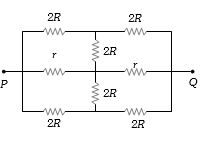
- 6The effective resistance between points $P$ and $Q$ of the electrical circuit shown in the figure isView Solution
- 7The current density is a solid cylindrical wire of radius $R ,$ as a function of radial distance $r$ is given by $J ( r )= J _{0}\left(1-\frac{ r }{ R }\right) .$ The total current in the radial region $r =0$ to $r =\frac{ R }{4}$ will beView Solution
- 8The potential difference between $A$ and $B$ in the Figure is ................. $V$View Solution

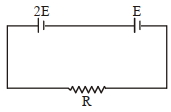
- 9Two cells of emf $2\, E$ and $E$ with internal resistance $r _{1}$ and $r _{2}$ respectively are connected in series to an external resistor $R$ (see $figure$). The value of $R ,$ at which the potential difference across the terminals of the first cell becomes zero isView Solution
- 10Find the maximum charge on the capacitor $C$ in the following circuit ............ $\mu C$View Solution