Question
A rainbow is an example of dispersion of sunlight. Justify this statement by explaining, with a neat labelled diagram, the formation of a rainbow in the sky. List two essential conditions for observing a rainbow.
Answer

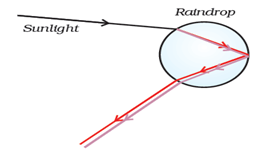
  • A rainbow is a natural spectrum appearing in the sky after a rain shower. [figure]
  • Rainbow is caused by dispersion of sunlight on refraction by tiny water droplets, present in the atmosphere.
  • It is always formed in the direction opposite to that of the Sun.
  • So the rainbow is seen when the Sun is behind the observer.
  • Here, water droplets act like small prisms.
  • They first refract and disperse the incident sunlight, then reflect it internally (not necessarily total internal reflection) and finally refract it again while it comes out of the raindrop.

[Formation of the main or primary rainbow]
  • This phenomenon is shown using schematic diagram in the figure, using only one water drop out of many water drops.
  • From the figure one can say that, the water drop causes internal reflection once and refraction twice of the incident ray of sunlight.
  • Due to dispersion of light and internal reflection, different colours reach the observer’s eye.
  • Conditions for observing a rainbow:
  • $A.$ after rainfall/ at a water fountain.
  • $B.$ The Sun should be behind the observer.

Need a full question paper?

Generate a complete, print-ready paper with questions like this in minutes — across 16+ boards, with answer keys.

Start Generating Free