MCQ
A random variable $X$ has the probability distribution  ....For the events $E = \{ X$is prime number $\}$ and $F = \{ X < 4\} $, the probability of $P(E \cup F)$ is
$X$ $1$ $2$ $3$ $4$ $5$ $6$ $7$ $8$
$P(X)$ $0.15$ $0.23$ $0.12$ $0.10$ $0.20$ $0.08$ $0.07$ $0.05$
  • A
    $0.5$
  • $0.77$
  • C
    $0.35$
  • D
    $0.87$

Answer

Correct option: B.
$0.77$
b
(b) $E = \{ x$ is a prime number $\}$

$P(E) = P(2) + P(3) + P(5) + P(7) = 0.62,\,$

$F = \{ x < 4\} $, $P(F) = P(1) + P(2) + P(3) = 0.50$

and $P(E \cap F) = P(2) + P(3) = 0.35$

$\therefore $ $P(E \cup F) = P(E) + P(F) - P(E \cap F)$

$= 0.62+0.50 -0.35 = 0.77.$

Need a full question paper?

Generate a complete, print-ready paper with questions like this in minutes — across 16+ boards, with answer keys.

Start Generating Free

Similar questions

A random variable $X$ has the following distribution.
$X$12345678
$P(X)$0.150.230.120.100.200.080.070.05

For the event $E=\{X$ is prime number $\}$, find $P(E)$.
The integral $\int \frac{1}{\sqrt[4]{(x-1)^{3}(x+2)^{5}}} d x$ is equal to :

(where $\mathrm{C}$ is a constant of integration)

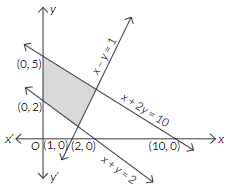
The feasible region corresponding to the linear constraints of a Linear Programming Problem is given belowImage

Which of the following is not a constraint to the given Linear Programming Problem?
Let $\alpha$ be a root of the equation $x^{2}+x+1=0$ and the matrix $A=\frac{1}{\sqrt{3}}\left[\begin{array}{ccc}{1} & {1} & {1} \\ {1} & {\alpha} & {\alpha^{2}} \\ {1} & {\alpha^{2}} & {\alpha^{4}}\end{array}\right],$ then the matrix $\mathrm{A}^{31}$ is equal to
The order of differential equation  $\frac{\text{d}^2\text{y}}{\text{dx}^2}-\Big(\frac{\text{dy}}{\text{dx}^2}\Big)=1$ is:
  1. one
  2. two
  3. four
  4. zero
If A = {a, b, c, d}, then a relation R = {(a, b), (b, a), (a, a)} on A is:
  1. Symmetric and transitive only.
  2. Reflexive and transitive only.
  3. Symmetric only.
  4. Transitive only.
The value of a for which the system of equations ${a^3}x + {(a + 1)^3}y + {(a + 2)^3}z = 0,$ $ax + (a + 1)y + (a + 2)z = 0,$ $x + y + z = 0,$ has a non zero solution is
If $f(x)=\sqrt{1+\cos ^2\left(x^2\right)}$, then the value of $f^{\prime}\left(\frac{\sqrt{\pi}}{2}\right)$ is
In figure, which of the following is not true?

  1. $​​​​​\overrightarrow{\text{AB}}+\overrightarrow{\text{BC}}+\overrightarrow{\text{CA}}=\vec0$

  2. $​​​​​\overrightarrow{\text{AB}}+\overrightarrow{\text{BC}}-\overrightarrow{\text{AC}}=\vec0$

  3. $​​​​​\overrightarrow{\text{AB}}+\overrightarrow{\text{BC}}-\overrightarrow{\text{CA}}=\vec0$

  4. $​​​​​\overrightarrow{\text{AB}}-\overrightarrow{\text{CB}}+\overrightarrow{\text{CA}}=\vec0$

If $u = x{y^2}{\tan ^{ - 1}}\left( {{y \over x}} \right)$, then $x{u_x} + y{u_y} = $