MCQ
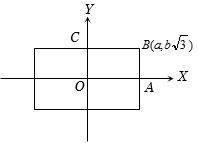
A rectangle is constructed in the complex plane with its sides parallel to the axes and its centre is situated at the origin. If one of the vertices of the rectangle is $a + ib\sqrt 3 $, then the area of the rectangle is
  • A
    $ab\sqrt 3 $
  • B
    $2ab\sqrt 3 $
  • C
    $3ab\sqrt 3 $
  • $4ab\sqrt 3 $

Answer

Correct option: D.
$4ab\sqrt 3 $
d
(d) Area of required rectangle $= 4×$area of $OABC$
$ = 4 \times a \times b\sqrt 3 = 4ab\sqrt 3 $.

Need a full question paper?

Generate a complete, print-ready paper with questions like this in minutes — across 16+ boards, with answer keys.

Start Generating Free

Similar questions

If ${z_1} = 1 - i$ and ${z_2} = - 2 + 4i$, then ${\mathop{\rm Im}\nolimits} \left( {\frac{{{z_1}{z_2}}}{{{z_1}}}} \right) = $
The common chord of two intersecting circles $c_1\,\, \& \,\,c_2$ can be seen from their centres at the angles of $90^o$ and $60^o$ respectively . If the distance between their centres is equal to $\sqrt{3} + 1$ then the radii of $c_1\,\, \& \,\,c_2$ are :
The sum of the digits in the unit's place of all the $4-$ digit numbers formed by using the numbers $3, 4 , 5$ and $6$, without repetition, is
If the equation $a| z |^{2}+\overline{\bar{\alpha} z +\alpha \overline{ z }}+ d =0$ represents $a$ circle where $a,d$ are real constants then which of the following condition is correct ?
If $a, b$ are positive real numbers such that the lines $a x+9 y=5$ and $4 x+b y=3$ are parallel, then the least possible value of $a +b$ is
If the variance of the following frequency distribution :

Class $10-20$ $20-30$ $30-40$
Frequency $2$ $x$ $2$

 then $x$ is equal to 

If $a=\lim _{x \rightarrow 0} \frac{\sqrt{1+\sqrt{1+x^4}}-\sqrt{2}}{x^4}$ and $b=\lim _{x \rightarrow 0} \frac{\sin ^2 x}{\sqrt{2}-\sqrt{1+\cos x}}$, then the value of $a b^3$ is
The product $2^{\frac{1}{4}} \cdot 4^{\frac{1}{16}} \cdot 8^{\frac{1}{48}} \cdot 16^{\frac{1}{128}} \cdot \ldots .$ to $\infty$ is equal to
Suppose $\theta \in\left[0, \frac{\pi}{4}\right]$ is a solution of $4 \cos \theta-3 \sin \theta=1$ Then $\cos \theta$ is equal to :
If $\alpha$ denotes the number of solutions of $|1-i|^x=2^x$ and $\beta=\left(\frac{|z|}{\arg (z)}\right)$, where $z=\frac{\pi}{4}(1+i)^4\left(\frac{1-\sqrt{\pi i}}{\sqrt{\pi}+i}+\frac{\sqrt{\pi}-i}{1+\sqrt{\pi} \mathrm{i}}\right), i=\sqrt{-1}$, then the distance of the point $(\alpha, \beta)$ from the line $4 x-3 y=7$ is