Question
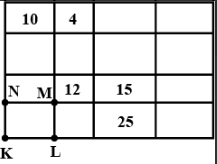
A rectangle is divided into $16$ sub-rectangles as in the figure, the number in each sub-rectangle represents the area of that sub-rectangle. What is the area of the rectangle $K L M N$ ?
Answer

d
(d)

Area of rectangles are

$a c=10$

$b c=4$

$b d=12$

$d e=15$

$e f=25$

$\therefore \frac{a c}{b c} \times \frac{b d}{d e} \times e f =\frac{10}{4} \times \frac{12}{15} \times 25$

$\Rightarrow a f =50$

Need a full question paper?

Generate a complete, print-ready paper with questions like this in minutes — across 16+ boards, with answer keys.

Start Generating Free

Similar questions

The lengths of the sides of a triangle are $10+ x ^{2}$, $10+ x ^{2}$ and $20-2 x ^{2}$. If for $x = k$, the area of the triangle is maximum, then $3 K ^{2}$ is equal to
If curves $y = ax^2 + bx + c$ and $y = px^2 + qx + r$ do not intersect each other and $a,b,c,p,q,r$ $\in$ $\{ 1,2,3,4,....,10\} ,$ then maximum value of $(aq -bp)^2 + (c -r)^2$ is-
How many words can be made from the letters of the word $DELHI$, if $L$ comes in the middle in every word
Let $\alpha>0, \beta>0$ be such that $\alpha^{3}+\beta^{2}=4 .$ If the maximum value of the term independent of $x$ in the binomial expansion of $\left(\alpha x^{\frac{1}{9}}+\beta x^{-\frac{1}{6}}\right)^{10}$ is $10 k$ then $\mathrm{k}$ is equal to
The value of $\sqrt {(\log _{0.5}^24)} $ is
If the sum of the first $11$ terms of the series ${\left( {1\frac{4}{7}} \right)^2} + {\left( {1\frac{5}{7}} \right)^2} + {\left( {1\frac{6}{7}} \right)^2} + {2^2} + {\left( {2\frac{1}{7}} \right)^2} + ......$ is $\frac{{11}}{7}\lambda $ then $\lambda $ is equal to
If $(x + 1)$ is a factor of ${x^4} - (p - 3){x^3} - (3p - 5){x^2}$ $ + (2p - 7)x + 6$, then $p = $
The area of the shorter region bounded by $|y| = 4\, -\, x^2$ and $|y| = 3x$ is given by $\left( {3K + \frac{1}{3}} \right)$ sq-unit where $K$ is equal to
If  $ [x] $ denotes the greatest integer less than or equal to $ x$ , then the value of $\int_{\,1}^{\,5} {\,\,[|x - 3|]\,dx} $ is
${\sin ^6}\theta + {\cos ^6}\theta + 3{\sin ^2}\theta {\cos ^2}\theta = $