Question
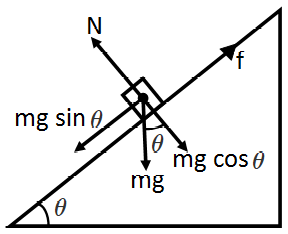
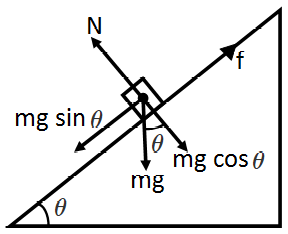
A rectangular box lies on a rough inclined surface. The coefficient of friction between the surface and the box is $\mu$. Let the mass of the box be m.
  1. At what angle of inclination $\theta$ of the plane to the horizontal will the box just start to slide down the plane?
  2. What is the force acting on the box down the plane, if the angle of inclination of the plane is increased to a $\theta>$?
  3. What is the force needed to be applied upwards along the plane to make the box either remain stationary or just move up with uniform speed?
  4. What is the force needed to be applied upwards along the plane to make the box move up the plane with acceleration a?
Answer

  1. As the box just start to slide down the plane then $\mu=\tan\theta$ (by angle of repose) $\theta-\tan^{-1}(\mu)$
  2. If angle$\alpha>\theta$ the angle of inclination of the plane with horizontal it will slide down (f upward) as $\theta$ is the angle of repose. So net force downward

$\text{F}_1=\text{mg}\sin\alpha-\text{f}=\text{mg}\sin\alpha-\mu\text{N}.$

$=\text{mg}\sin\alpha-\mu\ \text{mg}\cos\alpha$

$\text{F}_1=\text{mg}[\sin\alpha-\mu\cos\alpha]$

  1. To keep the box either stationary or just move it up with uniform velocity (1 =0)upward  (f downward)

$\text{F}_2-\text{mg}\sin\alpha-\text{f}=\text{ma}$

or $\text{F}_2-\text{mg}\sin\alpha-\mu\text{N}=0(\because\text{a}=0)$

$\text{F}_2=\text{mg}\sin\alpha-\mu\text{N}=0$

$\text{F}_2=\text{mg}(\sin\alpha-\mu\cos\alpha)$

  1. The force applied $\text{F}_2$ to move the box upward with acceleration a

$\text{F}_3-\text{mg}\sin\alpha-\mu\cos\alpha=\text{ma}$

$\therefore\text{F}_3=\text{mg}(\sin\alpha+\mu\cos\alpha)+\text{ma}$

Need a full question paper?

Generate a complete, print-ready paper with questions like this in minutes — across 16+ boards, with answer keys.

Start Generating Free

Similar questions

The period of oscillation of a simple pendulum is $\text{T}=2\pi\sqrt{4\text{g}}$Measured value of L is 20.0cm known to 1mm accuracy and time for 100 oscillations of the pendulum is found to be 90s using a wrist watch of 1s resolution. What is the accuracy in the determination of g?
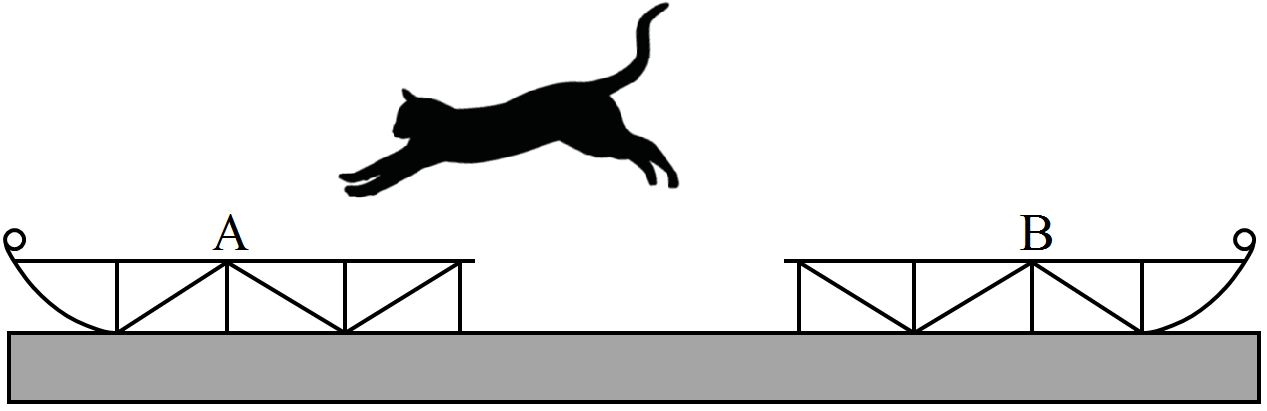
Two 22.7kg ice sleds A and B are placed a short distance apart, one directly behind the other, as shown in Fig. A 3.63kg cat, standing on one sled, jumps across to the other and immediately back to the first. Both jumps are made at a speed of 3.05ms-1 relative to the ice. Find the final speeds of the two sleds.

A spring balance has a scale that reads from 0 to 50kg. The length of the scale is 20cm. A body suspended from this balance, when displaced and released, oscillates with a period of 0.6s. What is the weight of the body?
The blades of a windmill sweep out a circle of area A.
  1. If the wind flows at a velocity v perpendicular to the circle, what is the mass of the air passing through it in time t?
  2. What is the kinetic energy of the air?
  3. Assume that the windmill converts 25% of the wind’s energy into electrical energy, and that A = 30 m2, v = 36km/h and the density of air is 1.2kgm-3. What is the electrical power produced?
A coil having an inductance L and a resistance R is connected to a battery of emf $\in.$ Find the time taken for the magnetic energy stored in the circuit to change from one fourth of the steady-state value to half of the steady-state value.
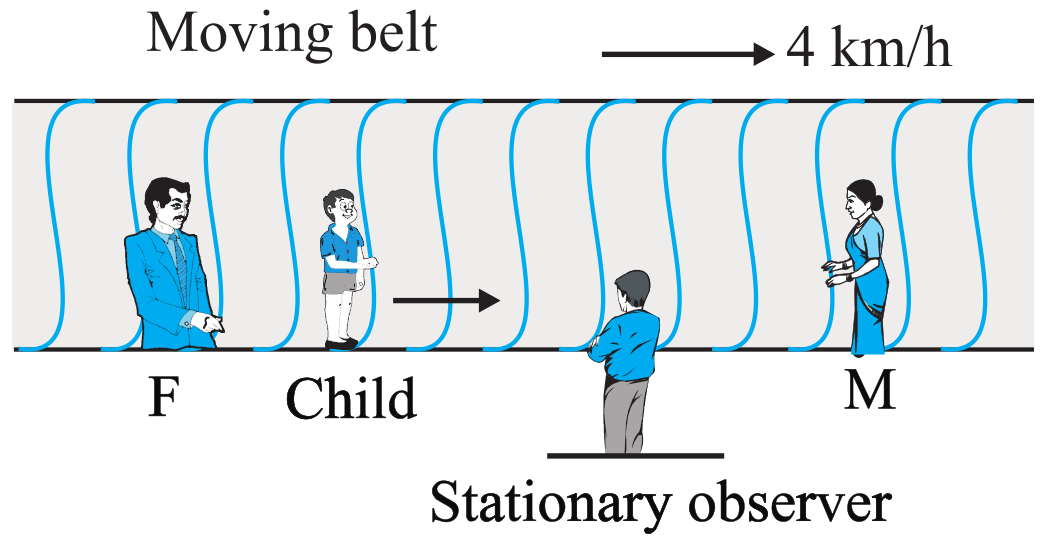
On a long horizontally moving belt a child runs to and fro with a speed 9km h–1 (with respect to the belt) between his father and mother located 50 m apart on the moving belt. The belt moves with a speed of 4km h–1. For an observer on a stationary platform outside, what is the

  1. speed of the child running in the direction of motion of the belt?.
  2. speed of the child running opposite to the direction of motion of the belt?
  3. time taken by the child in (a) and (b)?

Which of the answers alter if motion is viewed by one of the parents?

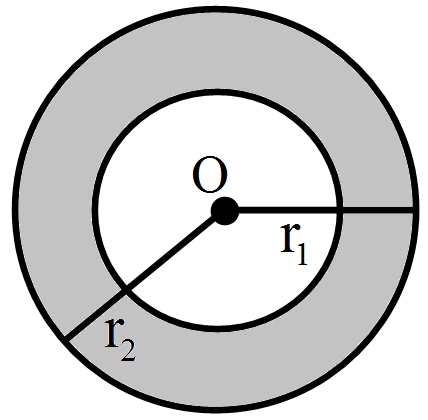
A charge Q is distributed uniformly within the material of a hollow sphere of inner and outer radii r1 and r2 (figure). Find the electric field at a point P a distance x away from the centre for r1 < x < r2 Draw a rough graph showing the electric field as a function of x for O < x < 2r2 (figure).

  1. What is the phenomenon of capillarity? Derive an expression for the rise of liquid in a capillary tube.
  2. What will happen if the length of the capillary tube is smaller than the height to which the liquid rises? Explain briefly.
A particle of mass 100g moving at an initial speed u collides with another particle of same mass kept initially at rest. If the total kinetic energy becomes 0.2J after the collision, what could be the minimum and the maximum value of u.
Explain fluid pressure.