Question
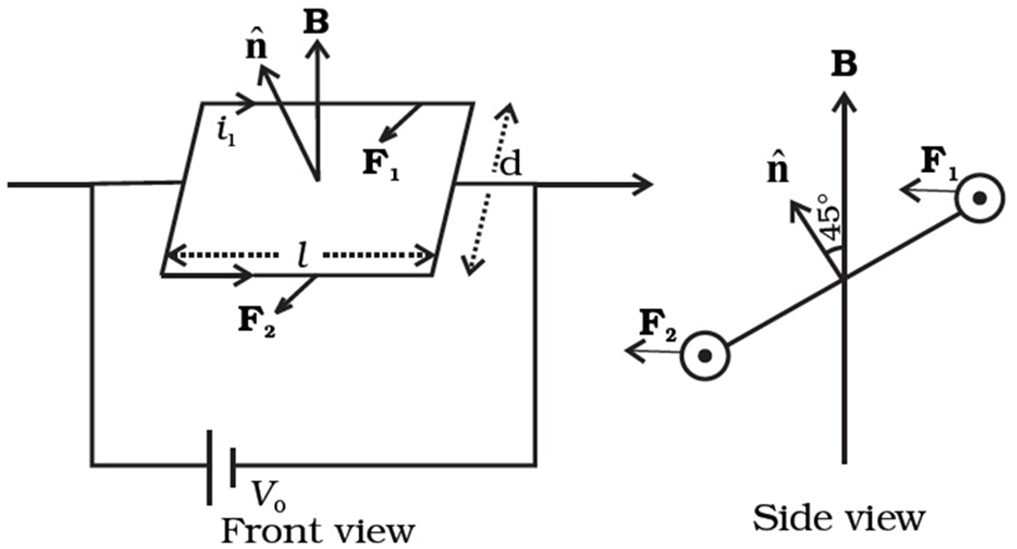
A rectangular conducting loop consists of two wires on two opposite sides of length l joined together by rods of length d. The wires are each of the same material but with cross-sections differing by a factor of 2. The thicker wire has a resistance R and the rods are of low resistance, which in turn are connected to a constant voltage source V0. The loop is placed in uniform a magnetic field B at 45° to its plane. Find $\tau$, the torque exerted by the magnetic field on the loop about an axis through the centres of rods.
Answer


Torque on the first wire is given by,
$\text{F}_1=\text{i}_1\text{lB}=\frac{\text{V}_0}{\text{R}}\text{lB},\tau_1=\frac{\text{d}}{2\sqrt{2}}\text{F}_1=\frac{\text{V}_0\text{ldB}}{4\sqrt{2}\text{R}}$
Torque on the second wire is given by,
$\text{F}_2=\text{i}_2\text{lB}=\frac{\text{V}_0}{2\text{R}}\text{lB},\tau_2=\frac{\text{d}}{2\sqrt{2}}\text{F}_2=\frac{\text{V}_0\text{ldB}}{4\sqrt{2}\text{R}}$
Net torque, $\tau=\tau_1-\tau_2$
$\Rightarrow\ \tau=\frac{1}{4\sqrt{2}}\frac{\text{V}_0\text{AB}}{\text{R}}.$

Need a full question paper?

Generate a complete, print-ready paper with questions like this in minutes — across 16+ boards, with answer keys.

Start Generating Free

Similar questions

A tightly-wound, long solenoid is kept with its axis parallel to a large metal sheet carrying a surface current. The surface current through a width dl of the sheet is Kdl and the number of turns per unit length of the solenoid is n. The magnetic field near the centre of the solenoid is found to be zero.
  1. Find the current in the solenoid.
  2. If the solenoid is rotated to make its axis perpendicular to the metal sheet, what would be the magnitude of the magnetic field near its centre ?
The amount of charge that passes in time t through a cross-section of a wire is,
Q(t) = At2 + Bt + C.
  1. Write the dimensional formulae for A, B and C.
  2. If the numerical values of A, B and C are 5, 3 and 1, respectively, in S.I units, find the value of the current at t = 5s.
A parallel-plate capacitor has plate area 25.0cm2 and a separation of 2.00mm between the plates. The capacitor is connected to a battery of 12.0V:
  1. Find the charge on the capacitor.
  2. The plate separation is decreased to 1.00mm. Find the extra charge given by the battery to the positive plate.
Is it possible that in a Coolidge tube characteristic $\text{L}_\alpha$ X-rays are emitted but not $\text{K}_\alpha$ X-rays?
A magnetic field of $(4.0\times10^{-3}\vec{\text{k}})$ T exerts a force of $(4.0\vec{\text{i}}+3.0\vec{\text{j}})\times10^{-10}$ N on a particle with a charge of $1.0\times10^{-9}\text{C}$ and going in the x−y plane. Find the velocity of the particle.
Obtain an expression for motional electromotive force.
A metal ball of mass 1kg is heated by means of a 20W heater in a room at 20°C. The temperature of the ball becomes steady at 50°C.
  1. Find the rate of loss of heat to the surrounding when the ball is at 50°C.
  2. Assuming Newton's law of cooling, calculate the rate of loss of heat to the surrounding when the ball is at 30°C.
  3. Assume that the temperature of the ball rises uniformly from 20°c to 30°C in 5 minutes. Find the total loss of heat to the surrounding during this period.
  4. Calculate the specific heat capacity of the metal.
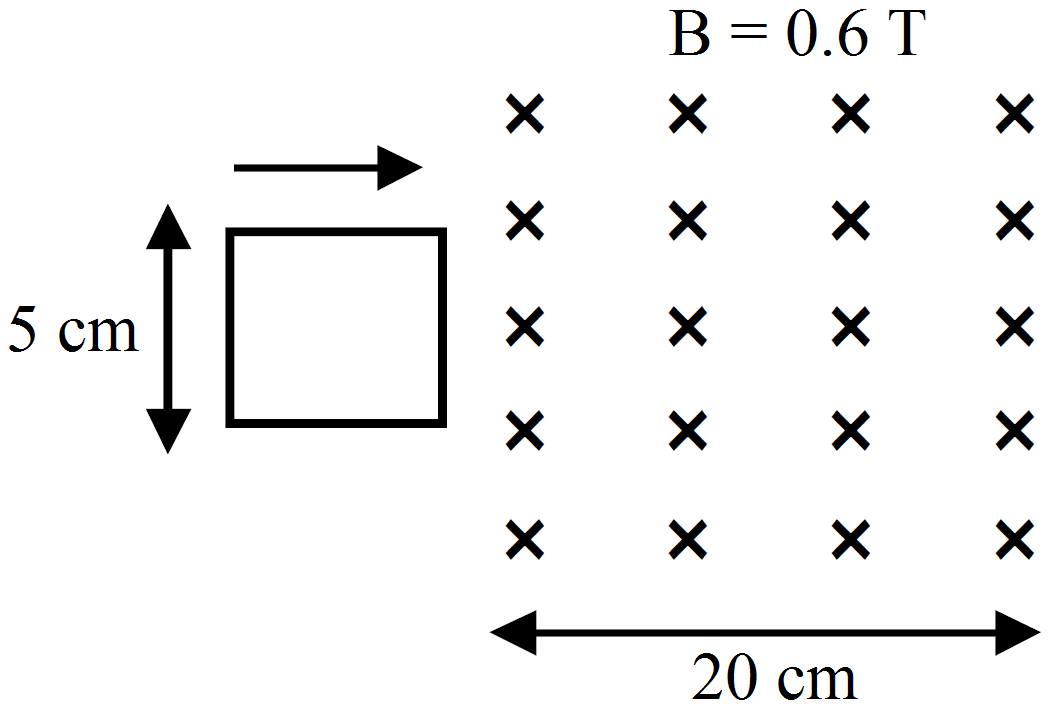
Figure shows a square loop of side 5cm being moved towards right at a constant speed of 1cm/s. The front edge enters the 20cm wide magnetic field at t = 0. Find the emf induced in the loop at:
  1. t = 2s
  2. t = 10s
  3. t = 22s
  4. t = 30s.

Establish an expression for force on a current carrying conductor kept in a magnetic field. Explain right hand palm rule for the direction of force.
An aluminium plate fixed in a horizontal position has a hole of diameter 2.000cm. A steel sphere of diameter 2.005cm rests on this hole. All the lengths refer to a temperature of 10°C. The temperature of the entire system is slowly increased. At what temperature willl the ball fall down? Coefficient of linear expansion of aluminium is 23 × 10-6 °C-1 and that of steel is 11 × 10-6 °C-1.