Question
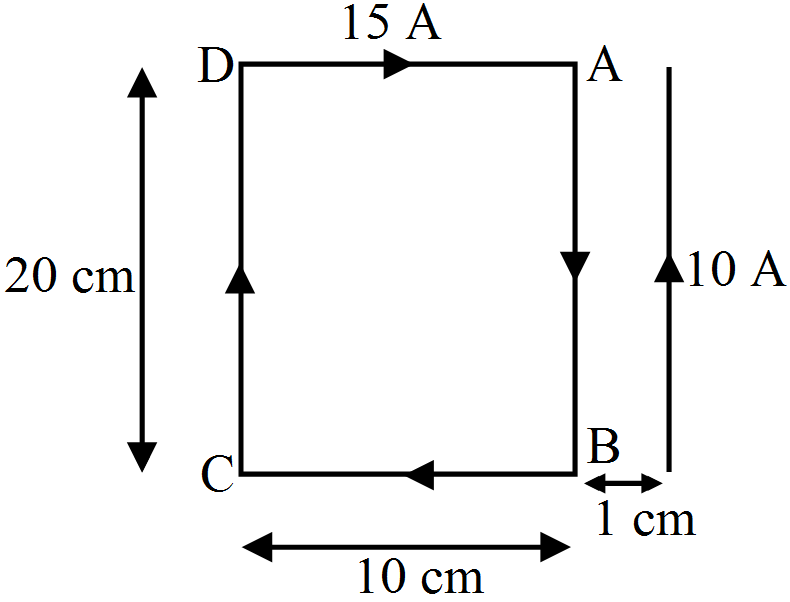
A rectangular current carrying loop is placed 1cm away from a long straight current-carrying conductor as shown.

  1. Will the net force acting on the loop due to straight conductor be attractive or repulsive in nature? Justify your answer. Calculate the magnitude of this force.

Answer

The net force acting on the loop will be repulsive in nature.

Justification:

Part AB of the loop will experience a force of repulsion whereas part CD will experience attraction. Parts BC and AD will not experience any force. Thus, the overall force will be a force of repulsion because AB is closer to the straight conductor than CD and the force between two current carrying conductors is inversely proportional to the distance between them.

$\text{F}=\frac{\mu_0}{2\pi}\frac{\text{I}_1\text{I}_2}{\text{r}}\text{l}$

Net Force

Force F1 on AB due to current in the straight conductor.

$\text{F}_1=\frac{\mu_0}{2\pi}\times\frac{2\times10\times15}{1\times10^{-2}}\times20\times10^{-2}$

= 3 × 10-4N towards left $\Big(\frac{\mu_0}{2\pi}=10^{-7}\Big)$

Force F2 on CD due to current in thw straight conductor.

$\text{F}_2=\frac{\mu_0}{2\pi}\times\frac{2\times10\times15}{11\times10^{-2}}\times20\times10^{-2}$

= 0.2725 ×10-4N towards right.

Hence, net force on the loop = 2.72N towards left.
Need a full question paper?

Generate a complete, print-ready paper with questions like this in minutes — across 16+ boards, with answer keys.

Start Generating Free

Similar questions

Consider a straight piece of length x of a wire carrying a current i. Let P be a point on the perpendicular bisector of the piece, situated at a distance d from its middle point. Show that for d >> x, the magnetic field at P varies as $\frac{1}{\text{d}^2}$ whereas ford d << x, it varies as $\frac{1}{\text{d}}.$
Write advantages and disadvantages of ac over dc and explain applied ac voltage over resistor.
State Gauss theorem in electrostatics. Apply this theorem to obtain the expression for the electric field at a point due to an infinitely long, thin, uniformly charged straight wire of linear charge density $\lambda\text{Cm}^{-1}.$
The force exerted by the floor of an elevator on the foot of a person standing there is more than the weight of the person if the elevator is:
  1. Going up and slowing down.
  2. Going up and speeding up.
  3. Going down and slowing down.
  4. Going down and speeding up.
 An electric kettle used to prepare tea, takes 2 minutes to boil 4 cups of water (1 cup contains 200cc of water) if the room temperature is 25C.
  1. If the cost of power consumption is Rs. 1.00 per unit (1 unit - 1000 watt-hour), calculate the cost of boiling 4 cups of water.
  2. What will be the corresponding cost if the room temperature drops to 5°C?
If the nucleons of a nucleus are separated from each other, the total mass is increased. Where does this mass come from?
Two parallel wires seprated by a distance of 10cm carry currents of 10A and 40A along-the same direction. Where should a third current be placed so that it experiences no magnetic force?
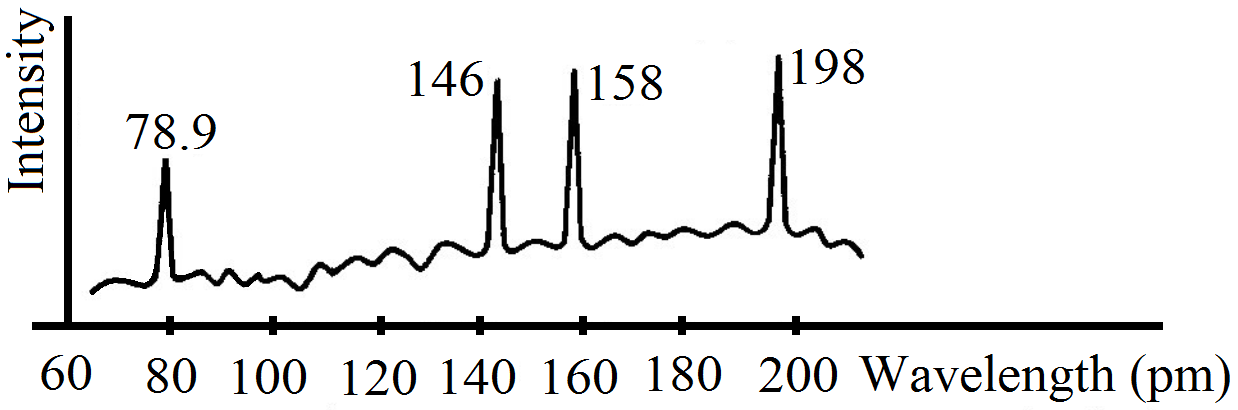
Continuous X-rays are made to strike a tissue paper soaked with polluted water. The incoming X-rays excite the atoms of the sample by knocking out the electrons from the inner shells. Characteristic X-rays are analysed and the intensity is plotted against the wavelength. Assuming that only $\text{K}_\alpha$ intensities are detected, list the elements present in the sample from the plot. Use Moseley's equation v - (25 × 1014Hz)(Z - 1)2.

A smooth sphere of radius R is made to translate in a straight line with a constant acceleration a. A particle kept on the top of the sphere is released from there at zero velocity with respect to the sphere. Find the speed of the particle with respect to the sphere as a function of the angle $\theta$ it slides.
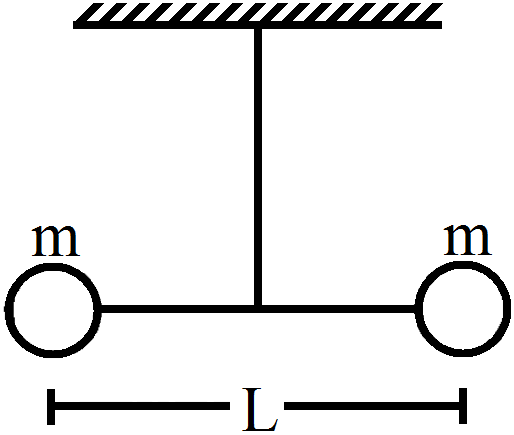
Two small balls, each of mass m are connected by a light rigid rod of length L. The system is suspended from its centre by a thin wire of torsional constant k. The rod is rotated about the wire through an angle $\theta_0$ and released. Find the tension in the rod' as the system passes through the mean position.