MCQ
A rectangular frame is to be suspended symmetrically by two strings of equal length on two supports. It can be done in one of the following three ways;
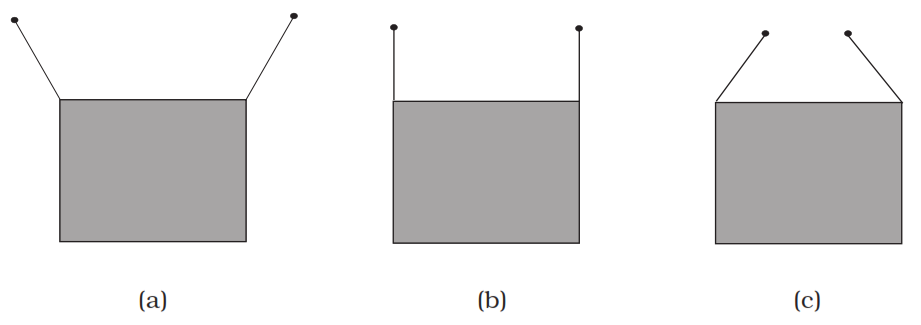
The tension in the strings will be
  • A
    The same in all cases.
  • B
    Least in $(a).$
  • Least in $(b)$.
  • D
    Least in $(c).$

Answer

Correct option: C.
Least in $(b)$.
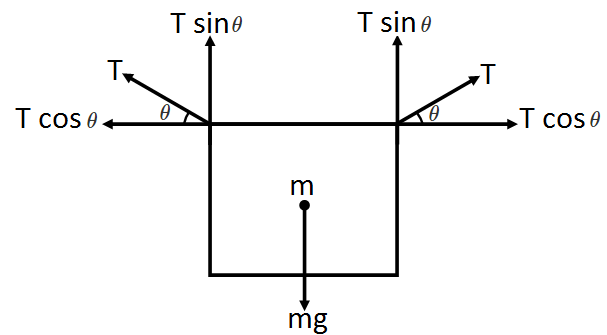
According to the $\text{FBD}$ diagram of the rectangular frame.
Let $M$ be the mass of rectangular frame and $0$ be the angle which the tension $T$ in the string makes with the horizontal

Balancing vertical forces,
$2\text{T}\sin\theta-\text{mg}=0 [T$ is tension in the string$]$
$\Rightarrow2\text{T}\sin\theta=\text{mg}$
Total horizontal force will be zero because of equal and opposite forces balance each other $(\text{T}\cos\theta).$
Now from Eq. $(i), \text{T}=\frac{\text{mg}}{2\sin\theta}$
Here, we know $mg$ is constant.
$\Rightarrow\text{T}\propto\frac{1}{\sin\theta}$
$T$ is least if $\sin\theta$ has maximum value.
$\text{T}_\text{min}=\frac{\text{mg}}{2\sin\theta_\text{max}}\text{ (since,}\sin\theta_{\text{max}}=1)$
$\sin\theta_\text{max}=1\Rightarrow\theta=90^\circ$
So the correct option is option $(c).$
Hence, tension is least for the case $(b).$

Need a full question paper?

Generate a complete, print-ready paper with questions like this in minutes — across 16+ boards, with answer keys.

Start Generating Free

Similar questions

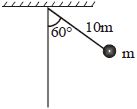
If pendulum is released from given position find velocity of Bob when it reaches the lowest position
A planet takes $200$ days to complete one revolution around the Sun. If the distance of the planet from Sun is reduced to one fourth of the original distance, how many days will it take to complete one revolution
Boiling water is changing into steam. Under this condition, the specific heat of water is
Three particles of equal mass $m$ are situated at the vertices of an equilateral triangle of side $l$. They are moving in a circle in influence of their mutual gravitational interaction. Then their time period of revolution is directly proportional to
Given below are two statements :

Statement $(I)$ : The mean free path of gas molecules is inversely proportional to square of molecular diameter.

Statement $(II)$ : Average kinetic energy of gas molecules is directly proportional to absolute temperature of gas.

In the light of the above statements, choose the correct answer from the option given below:

In an experiment of determine the Young's modulus of wire of a length exactly $1\; m$, the extension in the length of the wire is measured as $0.4\,mm$ with an uncertainty of $\pm 0.02\,mm$ when a load of $1\,kg$ is applied. The diameter of the wire is measured as $0.4\,mm$ with an uncertainty of $\pm 0.01\,mm$. The error in the measurement of Young's modulus $(\Delta Y)$ is found to be $x \times 10^{10}\,Nm ^{-2}$. The value of $x$ is

$\left[\right.$ Take $\left.g =10\,m / s ^{2}\right]$

The correct graph between the frequency $n$ and square root of density ($\rho$) of a wire, keeping its length, radius and tension constant, is
A body, thrown upwards with some velocity reaches the maximum height of $50 m$. Another body with double the mass thrown up with double the initial velocity will reach a maximum height of $..........\,m$
A cup of tea cools from $65.5^\circ C$ to $62.5^\circ C$ in one minute in a room of $22.5^\circ C.$ How long will the same cup of tea take to cool from $46.5^\circ C$ to $40.5^\circ C$ in the same room. $($Choose the nearest value in min.$)$
Initial angular velocity of a circular disc of mass $M$ is $\omega_{1}$. Then two small spheres of mass $m$ are attached gently to two diametrically opposite points on the edge of the disc. What is the final angular velocity of the disc?