Question

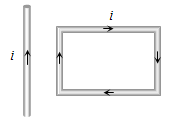
A rectangular loop carrying a current i is situated near a long straight wire such that the wire is parallel to the one of the sides of the loop and is in the plane of the loop. If a steady current I is established in wire as shown in figure, the loop will
(a) Rotate about an axis parallel to the wire

(b) Move away from the wire or towards right

(c) Move towards the wire

(d) Remain stationary

Answer

(c) Move towards the wire

Need a full question paper?

Generate a complete, print-ready paper with questions like this in minutes — across 16+ boards, with answer keys.

Start Generating Free

Similar questions

A conducting wire connects two charged conducting spheres such that they attain equilibrium with respect to each other. The distance of separation between the two spheres is very large as compared to either of their radii.
The ratio of the magnitudes of the electric fields at the surfaces of the two spheres is

Time period for a magnet is T. If it is divided in four equal parts along its axis and perpendicular to its axis as shown then time period for each part will be

(a) 4T  

(b) T/4

(c) T/2     

(d) T

The magnitude of which of the following is proportional to the frequency of the wave?

When light is incident on a doubly refracting crystal, two refracted rays-ordinary ray (O-ray) and extra ordinary ray (E-ray) are produced. Then

(a) Both O-ray and E-ray are polarised perpendicular to the plane of incidence

(b) Both O-ray and E-ray are polarised in the plane of incidence

(c) E-ray is polarised perpendicular to the plane of incidence and O-ray in the plane of incidence

(d) E-ray is polarised in the plane of incidence and O-ray perpendicular to the plane of incidence

Iron is :
Speed of electromagnetic waves in vacuum is:
Let I1 and I2 be the moments of inertia of two bodies of identical geometrical shape, the first made of aluminium and the second of iron.
  1. I1 < I2
  2. I1 = I2
  3. I1 < I2
  4. Relation between I1 and I2 depends on the actual shapes of the bodies. 
How will  the force between the two poles change if the two poles are connected by an iron rod keeping the distance between two magnetic poles constant ?

If the light moving in a straight line bends by a small but fixed angle, it may be a case of:

Assume you are sitting in sun for 2.5 hours. The area of your body exposed normally to sun rays 1.3m2. The intensity of sun rays is $\frac{1.1 \text{Kilowatt}}{\text{m}^2}$ If your body completely absorbs the sun rays then the momentum transferred to your body will be (in Kg - $\frac{\text{m}}{\text{s}}$):