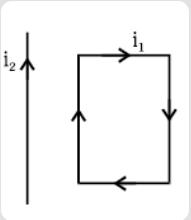
- AMove away from the wire
- BMove towards the wire
- CRemain stationary
- DRotate about an axis parallel to the wire

Explanation:
The magnetic field due to the straight current current carrying wire decreases with increasing distance from the wire.
Thus the magnetic field is stronger at the side closer to wire and weaker at the other.
Force on each segment of wire is BIL
Hence force acting on nearer side towards the wire is greater than the force acting on farther side away from wire. Hence the net force on loop is towards the wire.
Generate a complete, print-ready paper with questions like this in minutes — across 16+ boards, with answer keys.
The ratio of speed of an electron in ground state in Bohrs first orbit of hydrogen atom to velocity of light in air is
|
(a) |
(b) |
(c) |
(d) |
For a medium, refractive indices for violet, red and yellow are 1.62, 1.52 and 1.55 respectively, then dispersive power of medium will be
|
(a) 0.65 |
(b) 0.22 |
(c) 0.18 |
(d) 0.02 |
$\text{Zero.}$
$\text{v}_0$
$\sqrt2\text{v}_0$
$2\text{v}_0$
Two capacitors of capacities
and
are charged to voltages
and
respectively. There will be no exchange of energy in connecting them in parallel, if
|
(a) |
(b) |
(c) |
(d) |
Angle between equipotential surface and lines of force is
|
(a) Zero |
(b) 180° |
(c) 90° |
(d) 45° |
The two slits at a distance of 1 mm are illuminated by the light of wavelength 6.5 . The interference fringes are observed on a screen placed at a distance of 1m. The distance between third dark fringe and fifth bright fringe will be
|
(a) 0.65 mm |
(b) 1.63 mm |
(c) 3.25 mm |
(d) 4.88 mm |
A radioactive substance emits
|
(a) a-rays |
(b) b-rays |
(c) g-rays |
(d) All of these |