Question
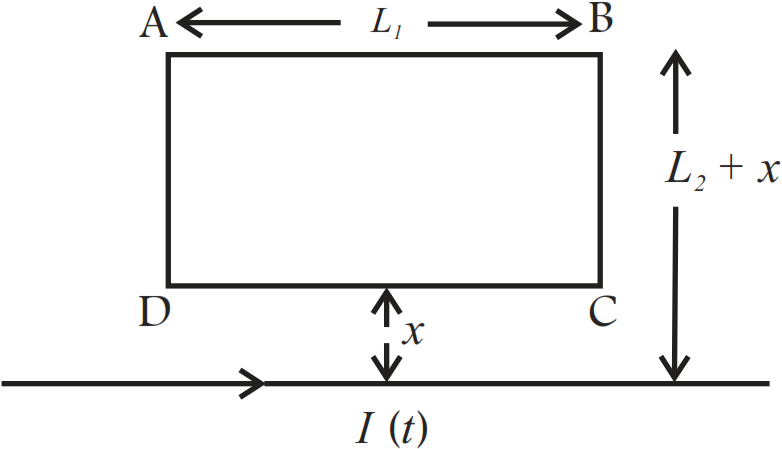
A rectangular loop of wire ABCD is kept close to an infinitely long wire carrying a current $\text{I}(\text{t})=\text{I}_0\Big(1-\frac{\text{t}}{\text{T}}\Big)$ for 0 and I(0) = 0 for t > T (Fig). Find the total charge passing through a given point in the loop, in time T. The resistance of the loop is R.
Answer

To find the charge that passes through the circuit first we have to find the relation between instantaneous current and instantaneous magnetic flux linked with it. The emf induced can be obtained by differentiating the expression of magnetic flux linked w.r.t. t and then applying Ohm's law, we get
$\text{I}=\frac{\text{E}}{\text{R}}=\frac{1}{\text{R}}\frac{\text{d}\phi}{\text{dt}}$
According to the problem electric current is given as a function of time.
$\text{I(t)}=\frac{\text{dQ}}{\text{dt}}\text{ or }\frac{\text{dQ}}{\text{dt}}=\frac{1}{\text{R}}\frac{\text{d}\phi}{\text{dt}}$
Integrating the variable separately in the form of differential equation for finding the charge Q that passed in time t, we have
$\text{Q}(\text{t}_1)=\text{Q}(\text{t}_2)=\frac{1}{\text{R}}\big[\phi(\text{t}_1)-\phi(\text{t}_2)\big]$
$\phi(\text{t}_1)\text{L}_1\frac{\mu_0}{2\pi}\int_\text{x}^{\text{L}_2+\text{x}}\frac{\text{dx}'}{\text{x}'}\text{I}(\text{t}_1)$ [Refer to the Eq. (i) of answer no. 25]
$=\frac{\mu_0\text{L}_1}{2\pi}\text{I}(\text{t}_1)\text{in}\frac{\text{L}_2+\text{x}}{\text{x}}$
Therefore the magnitude of charge is
$\text{Q}=\frac{1}{\text{R}}[\phi(\text{T})-\phi(0)]$
$\text{Q}=\frac{\mu_0\text{L}_1}{2\pi}\text{ in }\frac{\text{L}_2+\text{x}}{\text{x}}[\text{I}(\text{T})-\text{I}(0)]$
Now I(T) = 0 and I(0) = 1.
$\therefore\ \text{Q}=\frac{\mu_0\text{L}_1}{2\pi}\text{I}_0\text{ in }\bigg(\frac{\text{L}_2+\text{x}}{\text{x}}\bigg)$
This is the required expression.

Need a full question paper?

Generate a complete, print-ready paper with questions like this in minutes — across 16+ boards, with answer keys.

Start Generating Free

Similar questions

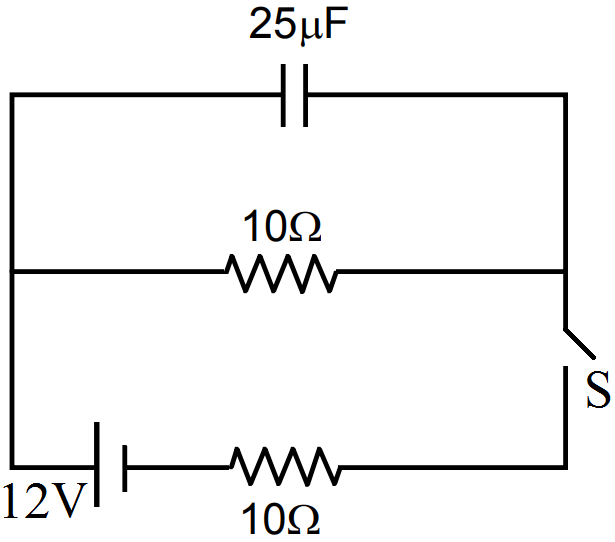
The switch S shown in figure. is kept closed for a long time and is then opened at t = 0. Find the current in the middle $1.0\Omega$ resistor at t = 1ms.

The rectangular wire-frame, shown in figure, has a width d, mass m, resistance R and a large length. A uniform magnetic field B exists to the left of the frame. A constant force F starts pushing the frame into the magnetic field at t = 0.
  1. Find the acceleration of the frame when its speed has increased to v.
  2. Show that after some time the frame will move with a constant velocity till the whole frame enters into the magnetic field. Find this velocity v0.
  3. Show that the velocity at time t is given by $\text{v}=\text{v}_0\Big(1-\text{e}^{-\frac{\text{ft}}{\text{mv}_0}}\Big)$

A constant current exists in an inductor-coil connected to a battery. The coil is short-circuited and the battery is removed. Show that the charge flown through the coil after the short-circuiting is the same as that which flows in one time constant before the short-circuiting.
State Soddy-Fajan’s displacement laws for radioactive transformations.
The short-wavelength limit shifts by 26pm when the operating voltage in an X-ray tube is increased to 1.5 times the original value. What was the original value of the operating voltage?
i. An ac source generating a voltage $V = V _0 \sin \omega t$ is connected to a capacitor of capacitance C . Find the expression of the current I flowing through it. Plot a graph of $V$ and I versus $\omega t$ to show that the current is $\frac{\pi}{2}$ ahead of the voltage.
ii. A resistor of $200 \Omega$ and a capacitor of $15 \mu F$ are connected in series to a $220 V, 50 Hz$ ac source. Calculate the current in the circuit and the rms voltage across the resistor and the capacitor. Why the algebraic sum of these voltages is more than the source voltage?
Define electric dipole moment. Calculate the value of electric potential generated from electric dipole and prove that its value is maximum at the point situated on the axis and zero at the equatorial point? ###Define electric dipole moment of electric dipole. Obtain an expression for the electric potential at a common point due to electric dipole. Also draw necessary diagram.
The bob of a simple pendulum has a mass of 40g and a positive charge of 4.0 × 10-6C. It makes 20 oscillations in 45s. A vertical electric field pointing upward and of magnitude 2.5 × 104NC-1 is switched on. How much time will it now take to complete 20 oscillations?
 An electric kettle used to prepare tea, takes 2 minutes to boil 4 cups of water (1 cup contains 200cc of water) if the room temperature is 25C.
  1. If the cost of power consumption is Rs. 1.00 per unit (1 unit - 1000 watt-hour), calculate the cost of boiling 4 cups of water.
  2. What will be the corresponding cost if the room temperature drops to 5°C?
A certain element emits $\text{K}_\alpha$ X-ray of energy 3.69keV. Use the data from the previous problem to identify the element.