Question
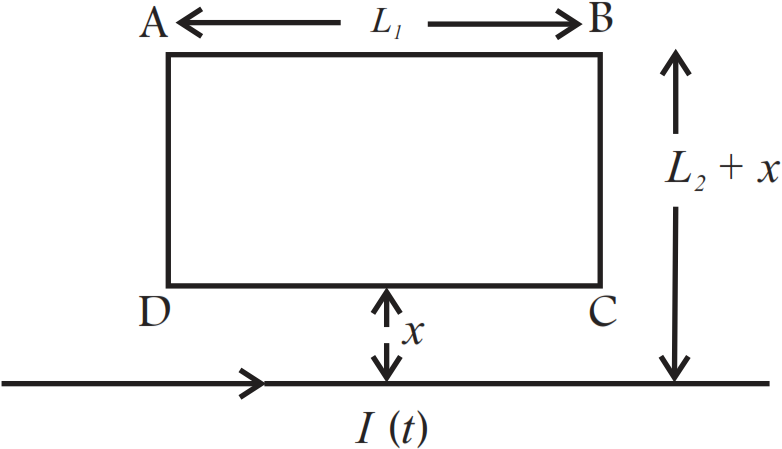
A rectangular loop of wire ABCD is kept close to an infinitely long wire carrying a current $\text{I}(\text{t})=\text{I}_0\Big(1-\frac{\text{t}}{\text{T}}\Big)$ for 0 and I(0) = 0 for t > T (Fig). Find the total charge passing through a given point in the loop, in time T. The resistance of the loop is R.
Answer

To find the charge that passes through the circuit first we have to find the relation between instantaneous current and instantaneous magnetic flux linked with it. The emf induced can be obtained by differentiating the expression of magnetic flux linked w.r.t. t and then applying Ohm's law, we get
$\text{I}=\frac{\text{E}}{\text{R}}=\frac{1}{\text{R}}\frac{\text{d}\phi}{\text{dt}}$
According to the problem electric current is given as a function of time.
$\text{I(t)}=\frac{\text{dQ}}{\text{dt}}\text{ or }\frac{\text{dQ}}{\text{dt}}=\frac{1}{\text{R}}\frac{\text{d}\phi}{\text{dt}}$
Integrating the variable separately in the form of differential equation for finding the charge Q that passed in time t, we have
$\text{Q}(\text{t}_1)=\text{Q}(\text{t}_2)=\frac{1}{\text{R}}\big[\phi(\text{t}_1)-\phi(\text{t}_2)\big]$
$\phi(\text{t}_1)\text{L}_1\frac{\mu_0}{2\pi}\int_\text{x}^{\text{L}_2+\text{x}}\frac{\text{dx}'}{\text{x}'}\text{I}(\text{t}_1)$ [Refer to the Eq. (i) of answer no. 25]
$=\frac{\mu_0\text{L}_1}{2\pi}\text{I}(\text{t}_1)\text{in}\frac{\text{L}_2+\text{x}}{\text{x}}$
Therefore the magnitude of charge is
$\text{Q}=\frac{1}{\text{R}}[\phi(\text{T})-\phi(0)]$
$\text{Q}=\frac{\mu_0\text{L}_1}{2\pi}\text{ in }\frac{\text{L}_2+\text{x}}{\text{x}}[\text{I}(\text{T})-\text{I}(0)]$
Now I(T) = 0 and I(0) = 1.
$\therefore\ \text{Q}=\frac{\mu_0\text{L}_1}{2\pi}\text{I}_0\text{ in }\bigg(\frac{\text{L}_2+\text{x}}{\text{x}}\bigg)$
This is the required expression.

Need a full question paper?

Generate a complete, print-ready paper with questions like this in minutes — across 16+ boards, with answer keys.

Start Generating Free

Similar questions

A solenoid having inductance 4.0H and resistance $10\Omega$ is connected to a 4.0V battery at t = 0. Find
  1. The time constant.
  2. The time elapsed before the current reaches 0.63 of its steady-state value.
  3. The power delivered by the battery at this instant.
  4. The power dissipated in Joule heating at this instant.
A system has two charges $\mathrm{q}_{\mathrm{A}}=2.5 \times 10^{-7} \mathrm{C}$ and $\mathrm{q}_{\mathrm{B}}=-2.5 \times 10^{-7} \mathrm{C}$ located at points $\mathrm{A}:(0,0,-15 \mathrm{~cm})$ and $\mathrm{B}:(0,0,+15 \mathrm{~cm})$, respectively. What are the total charge and electric dipole moment of the system?
Natural water contains a small amount of tritium $\big(\text{ }^3_1\text{H}\big).$ This isotope beta-decays with a half-life of 12.5 years. A mountaineer while climbing towards a difficult peak finds debris of some earlier unsuccessful attempt. Among other things he finds a sealed bottled of whisky. On returning, he analyses the whisky and finds that it contains only 1.5 per cent of the $\text{}^3_1\text{H}$ radioactivity as compared to a recently purchased bottle marked '8 years old'. Estimate the time of that unsuccessful attempt.
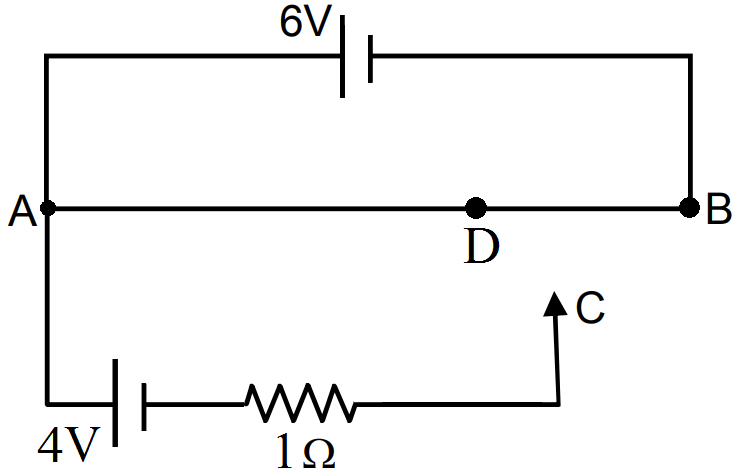
A 6 volt battery of negligible internal resistance is connected across a uniform wire AB of length 100cm. The positive terminal of another battery of emf 4V and internal resistance $1\Omega$ is joined to the point A, as shown in the figure. Take the potential at B to be zero. (a) What are the potentials at the points A and C? (b) At which point D of the wire AB, the potential is equal to the potential at C? (c) If the points C and D are connected by a wire, what will be the current through it? (d) If the 4V battery is replaced by a 7.5V battery, what would be the answers of parts (a) and (b)?
A charge is distributed uniformly over a ring of radius ‘a’. Obtain an expression for the electric intensity E at a point on the axis of the ring. Hence show that for point’s at large distances from the ring, it behaves like a point charge.
A beam of monochromatic light of wavelength $\lambda$ ejects photoelectrons from a cesium surface $\big(\Phi=1.9\text{eV}\big).$ These photoelectrons are made to collide with hydrogen atoms in ground state. Find the maximum value of $\lambda$ for which (a) hydrogen atoms may be ionized, (b) hydrogen atoms may get excited from the ground state to the first excited state and (c) the excited hydrogen atoms may emit visible light.
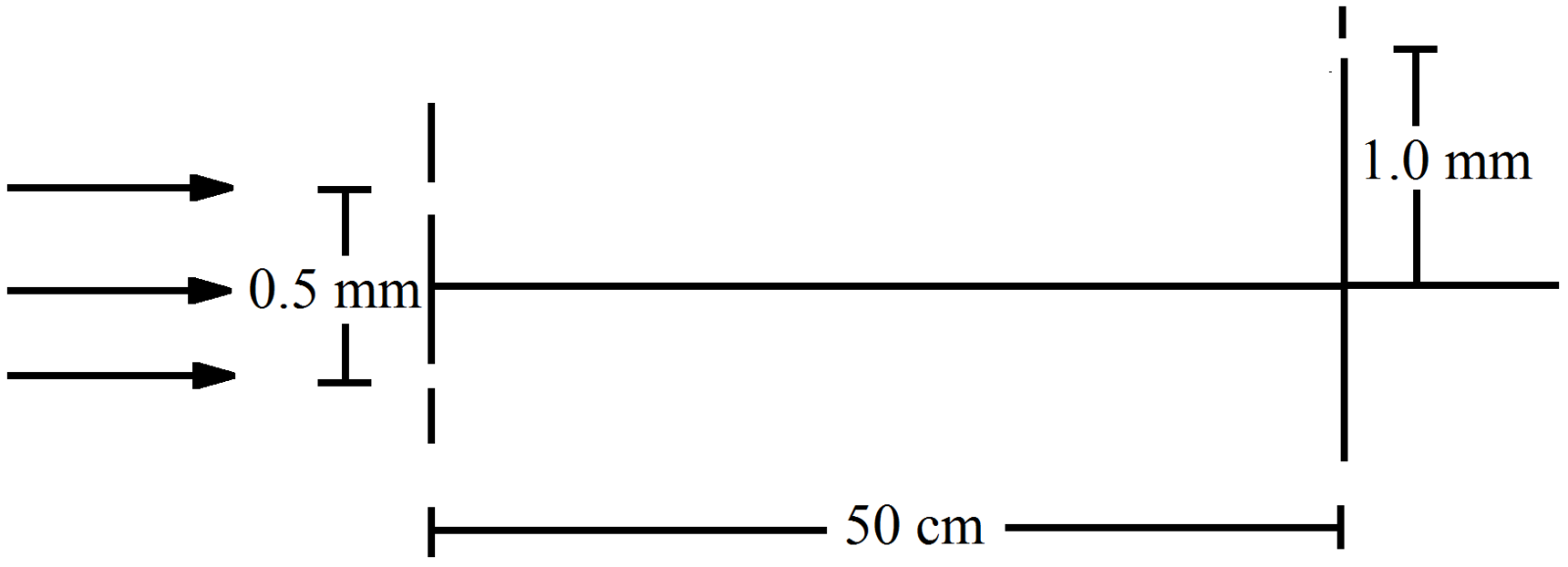
White coherent light (400nm - 700nm) is sent through the slits of a Young's double slit experiment (figure.) The separation between the slits is 0.5mm and the screen is 50cm away from the slits. There is a hole in the screen at a point 1.0mm away (along the width of the fringes) from the central line.
  1. Which wavelength (s) will be absent in the light coming from the hole?
  2. which wavelength (s) will have a strong intensity?
To ensure almost 100 per cent transmittivity, photographic lenses are often coated with a thin layer of dielectric material. The refractive index of this material is intermediated between that of air and glass (which makes the optical element of the lens). A typically used dielectric film is $MgF_2 (n = 1.38).$ What should the thickness of the film be so that at the center of the visible speetrum $(5000\mathring{\text{A}})$ there is maximum transmission.
  1. Explain the formation of depletion layer and potential barrier in a p-n junction.
  2. In the figure given below the input waveform is converted into the output waveform by a device ‘X’. Name the device and draw its circuit diagram.
  1. Identify the logic gate represented by the circuit as shown and write its truth table.
Consider the Atwood machine of the previous problem. The larger mass is stopped for a moment 2.0s after the system is set into motion. Find the time elapsed before the string is tight again.