Question
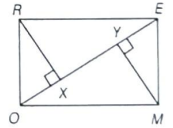
A rectangular MORE is shown below :
Image
Answer the following questions by giving appropriate reason.
(i) Is $R E=O M?$
(ii) Is $\angle MYO =\angle R X E?$
(iii) Is $\angle M O Y=\angle R E X?$
(iv) Is $\triangle M Y O \cong \triangle R X E?$

Answer

(i) Yes, $R E=O M$
Given, the above rectangle, opposite sides are equal.
(ii) Yes, $\angle M Y O=\angle R X E$
Here, $M Y$ and $R X$ are perpendicular to $O E$.
Since, $\angle R X O=90^{\circ} \Rightarrow \angle R X E=90^{\circ}$
and $\angle M Y E=90^{\circ} \Rightarrow \angle M Y O=90^{\circ}$
(iii) Yes, $\angle M O Y=\angle R E X\quad$ [Since, these are alternate interior angles, as $R E \| O M$ and $E O$ is a transversal]
(iv) Yes, $\triangle M Y O \cong \triangle R X E$
In $\triangle M Y O$ and $\triangle R X E$, we see that
$M O=R E \qquad\qquad\qquad\text{ [proved]}$
$ \angle M O Y=\angle R E X \qquad\quad\text{ [proved]}$
$ \angle M Y O=\angle R X E \qquad\quad\text{ [proved]}$
$ \therefore \triangle M Y O \cong \triangle R X E\quad\quad\text{[by AAS]}$

Need a full question paper?

Generate a complete, print-ready paper with questions like this in minutes — across 16+ boards, with answer keys.

Start Generating Free

Similar questions

The following chart gives the growth in height in terms of percentage of full height of boys and girls with their respective ages.
Age $($in years$)$ $8$ $9$ $10$ $11$ $12$ $13$ $14$ $15$ $16$ $17$ $18$
Boys $72\%$ $75\%$ $78\%$ $81\%$ $84\%$ $88\%$ $92\%$ $95\%$ $98\%$ $99\%$ $100\%$
Girls $77\%$ $81\%$ $84\%$ $88\%$ $91\%$ $95\%$ $98\%$ $99\%$ $99.5\%$ $100\%$ $100\%$
Draw the line graph of above data on the same sheet and answer the following questions.
$a.$ In which year both the boys and the girls achieve their maximum height?
$b.$ Who grows faster at puberty $(14$ years to $16$ years of age$)?$
Deepak and his family went on a road trip by car. They visited four cities. City 1 was 500 km from their home. The petrol tank in their car has a capacity of 35 litres. The car runs 20 km on one litre.
City 1City 2City 3City 4
Distance travelled by the car500100015002000
From City 4, they travelled 500 km to reach home.
(i) How many litres of petrol did they use to complete the road trip?
(a) 100 $\qquad$ (b) 125 $\qquad$ (c) 200 $\qquad$ (d) 2500
(ii) The family travelled 500 km In a day. What is the smallest number of days in which the road trip can be completed?
(iii) The car travelled at a uniform speed of $75 km / h$ between City 3 and City 4 . How much distance did car travel in 20 min ?
(iv) The family started their journey from City 3 at 10 am . By what time will they reach half the distance to City 4 ?
(a) 12 pm $\qquad$ (b) 1:30 pm $\qquad$ (c) 1:20 pm $\qquad$ (d) 3 pm
Find the square root of the following decimal numbers.
$2.56$
Find the least number which must be subtracted from each of the following numbers so as to get a perfect square. Also find the square root of the perfect square so obtained.
$402$
Find the area of a rhombus whose side is $6\ cm$ and whose altitude is $4\ cm$. If one of its diagonals is $8\ cm$ long, find the length of the other diagonal.
Find the least number which must be added to each of the following numbers so as to get a perfect square. Also find the square root of the perfect square so obtained.$1825$
There are $m$ boys and $n$ girls in a class. Each boy donated twice as many rupees as is the total number of boys and each girl donated thrice as many rupees as is the total number of girls. The boys collected ₹1152 in all while the girls collected ₹768 in all.
(1) What is the value of $m$ ?
(a) 22$\quad$(b) 24$\quad$(c) 26$\quad$(d) 28
(2) What is the value of $n$ ?
(a) 12$\quad$(b) 14$\quad$(c) 16$\quad$(d) 18
(3) Had there been $(m+3)$ boys and $(n-3)$ girls in the class, the total amount collected would be
(a) ₹ 1925$\quad$(b) ₹ 1940(c) ₹ 1965$\quad$(d) ₹ 2000
(4) Let $p=m^2+n^2$. Then, which of the following is true for $p$ ?
(a) $p$ is a perfect square.(b) $(p+9)$ is a perfect square.(c) $(p+2)$ is a perfect square.(d) $(p-32)$ is a perfect square.
(5) Let $q=m^2-n^2$. Then, the least number to be added to $q$ to make it a perfect square is
(a) 4(b) 6(c) 8(d) 12
Find the square root of each of the following numbers by Division method. $2304$
Find ten rational numbers between $\frac{3}{5}\ \text{and}\ \frac{3}{4}$
Using Euler’s formula, find the value of unknown $x, y, z, p, q, r,$ in the following table.
Faces $9$
Vertices $z$
Edges $16$