MCQ
A reduction in atomic size with increase in atomic number is a characteristic of elements of:
  • A
    $D-$block.
  • $F-$block.
  • C
    Radioactive series.
  • D
    High atomic masses.

Answer

Correct option: B.
$F-$block.
A reduction in atomic size with increase in atomic number is a characteristic of $f-$block elements.
This is due to poor shielding of $f$ electrons. The extent of actinoid contraction is greater than lanthanoid contraction. With increase in atomic number i.e. in moving down a group, the number of the principal shell increases and therefore, the size of the atom increases. But in case of $f$ ­block elements there is a steady decrease in atomic size with increase in atomic number due to lanthanide contraction. As we move through the lanthanide series$, 4f$ electrons are being added one at each step.
The mutual shielding effect of $f$ electrons is very little. This is due to the shape of the $f$ ­orbitals. The nuclear charge, however increases by one at each step. Hence, the inward pull experienced by the $4f$ electrons increases. This causes a reduction in the size of the entire 4fn shell.

Need a full question paper?

Generate a complete, print-ready paper with questions like this in minutes — across 16+ boards, with answer keys.

Start Generating Free

Similar questions

(figure) $\xrightarrow{{N{H_2} - OH}}$ product ; product is 
The cell potential for $Zn \left| Zn ^{2+}( aq ) \| Sn ^{ x +}\right| Sn$ is $0.801$ $V$ at $298\,K$. The reaction quotient for the above reaction is $10^{-2}$. The number of electrons involved in the given electrochemical cell reaction is. .... (Given $E _{ Zn ^{2+} \mid Zn }^{0}=-0.763\,V , E _{ Sn ^{ x +} \mid Sn }^{0}=+0.008\,V$ and $\left.\frac{2.303\,RT }{ F }=0.06\,V \right)$
The product of mustard oil reaction is
A metal complex of coordination number six having three different types of ligands  $a, b$ and $c$ of composition $Ma_2b_2c_2$ can exist in several geometrical  isomeric forms; the total number of such isomers is
Which of the following is not a favourable condition for physical adsorption?
A solution is made by dissolving $20\, g$ of a substance in $500\, mL$ of water. Its osmotic pressure was found to be $600\, mm$ of $Hg$ at $15\,^oC$. The molecular weight of the substance is
Given below are two statements:

Statement $(I)$ : Aminobenzene and aniline are same organic compounds.

Statement $(II)$ : Aminobenzene and aniline are different organic compounds.

In the light of the above statements, choose the most appropriate answer from the options given below:

Consider the following complex $[Co(NH_3)_5CO_3]ClO_4$. The coordination number, oxidation number, number of $d-$ electrons and number of unpaired $d-$ electrons on the metal are respectively
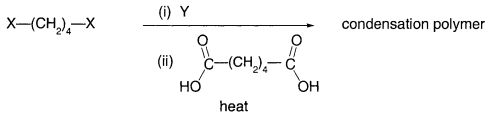
The correct functional group $X$ and the reagent/reaction conditions $Y$ in the following scheme are $Image$

$(A)$ $X = COOCH _3, Y = H _2 /$ Ni/heat

$(B)$ $X = CONH _2, Y = H _2 /$ Ni/heat

$(C)$ $X = CONH _2, Y = Br _2 / NaOH$

$(D)$ $X = CN , Y = H _2 /$ Ni/heat
The order of stability of carbonium ions is