MCQ
A reference frame attached to the earth:
  1. Is an inertial frame by definition.
  2. Cannot be an inertial frame because the earth is revolving around the sun.
  3. Is an inertial frame because Newton's laws are applicable in this frame.
  4. Cannot be an inertial frame because the earth is rotating about its axis.
  • A
    $A$ and $B$
  • $B$ and $D$
  • C
    $C$ and $D$
  • D
    $A$ and $D$

Answer

Correct option: B.
$B$ and $D$
A reference frame attached to the earth cannot be an inertial frame because the earth is revolving around the sun and also rotating about its axis.

Need a full question paper?

Generate a complete, print-ready paper with questions like this in minutes — across 16+ boards, with answer keys.

Start Generating Free

Similar questions

Water of volume $2$ litre in a container is heated with a coil of $1\,kW$ at $27\,^\circ C$. The lid of the container is open and energy dissipates at rate of $160\,J/s.$ In how much time temperature will rise from $27\,^\circ C$ to $77\,^\circ C$ [Given specific heat of water is $4.2\,kJ/kg$]
A parallel$-$plate capacitor has plates of unequal area. The larger plate is connected to the positive terminal of the battery and the smaller plate to its negative terminal. Let $Q_{+}$ and $Q$ be the charges appearing on the positive and negative plates respectively:
A particle experiences a constant acceleration for $20\, seconds$ after starting from rest. If it travels a distance $s_1$ in the first $10\, seconds$ and distance $s_2$ in the next $10\, seconds$, then :-
A rigid body is rotating with variable angular velocity $(a - bt)$ at any instant of time $ t.$ The total angle subtended by it before coming to rest will be ($a$ and $b$ are constants)
A force of $50\, dynes $ is acted on a body of mass $5 \,g$ which is at rest for an interval of $3 \,seconds$, then impulse is
The ratio of specific heats of a gas is $\frac{9}{7}$, then the number of degrees of freedom of the gas molecules for translational motion is :
Two particles of masses $m_1, m_2$ move with initial velocities $u_1$and $u_2$ On collision, one of the particles get excited to higher level, after absorbing energy $\varepsilon $. If final velocities of particles be $v_1$ and $v_2$ then we must have
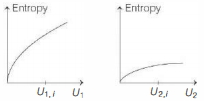
Graphs below show the entropy versus energy $U$ of two systems $1$ and $2$ at constant volume. The initial energies of the systems are indicated by $U_{1, i}$ and $U_{2, i}$, respectively. Graphs are drawn to the same scale. The systems are then brought into thermal contact with each other. Assume that, at all times the combined energy of the two systems remains constant. Choose the most appropriate option indicating the energies of the two systems and the total entropy after they achieve the equilibrium.
Two substances of densities ${\rho _1}$ and ${\rho _2}$ are mixed in equal volume and the relative density of mixture is $4$. When they are mixed in equal masses, the relative density of the mixture is $3$. The values of ${\rho _1}$ and ${\rho _2}$ are
The maximum velocity at the lowest point, so that the string just slack at the highest point in a vertical circle of radius $l$