MCQ
A reflecting telescope utilizes
  • A concave mirror
  • B
    A convex mirror
  • C
    A prism
  • D
    A plano-convex lens

Answer

Correct option: A.
A concave mirror
a
(a) Unlike convex mirrors, concave mirrors show different image types depending on the distance between the object and the mirror. That is why a reflecting telescope utilizes a concave mirror. If you observe the design of a reflecting telescope, it uses the incoming rays to focus through a concave mirror to focus on the second mirror which in turn sends the rays to the eye-piece. So, the concave mirror is intrinsic to the design of a reflecting telescope.
Need a full question paper?

Generate a complete, print-ready paper with questions like this in minutes — across 16+ boards, with answer keys.

Start Generating Free

Similar questions

If a high power heater is connected to electric mains, then the bulbs in the house become dim, because there is a
How many capacitors having at least 2 µF capacitance will give 5 µF capacitance?
The frequencies of X-rays, g-rays and ultraviolet rays are respectively a, b and c. Then
In a semiconductor, which of the following statement is correct?
The coercivity of a small magnet where the ferromagnet gets demagnetized is $3 \times 10^3 Am ^{-1}$. The current required to be passed in a solenoid of length $10 \ cm$ and number of turns $100$ , so that the magnet gets demagnetized when inside the solenoid, is:
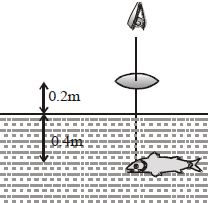
A smal fish $0.4\,m$ below the surface of a lake , is viewed through a simple converging lesn of focal length $3\,m.$ The lens is kept at $0.2\, m$ above the water surface such that fish lies on the optical axis of the lens. The image of the fish seen by oserver will be at  $\left( {{\mu _{water}} = \frac{4}{3}} \right)$
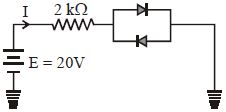
Assuming the diodes to be of silicon with forward resistance zero, the current $I$ in the  following circuit is.......$mA$
The ratio of specific charge of an α -particle to that of a proton is
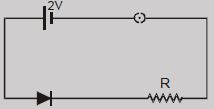
A $2\,V$ battery forward biases a diode. There is a drop of $0.5\,V$ across the diode which is independent of current. Also a current greater then $10\,mA$ produces large joule heat and damages diode. If diode is to be operated at $5\,mA,$ the series resistance to be put is
Assertion : The specific charge of positive rays is not constant.
Reason : The mass of ions varies with speed.