Question
A refrigerator, whose coefficient of performance is 5, extracts heat from the cooling compartment at the rate of 250 per cycle. How much heat per cycle is discharged to the room?

Answer

$\beta=\frac{\text{Q}_2}{\text{Q}_1-\text{Q}_2}$ or $5=\frac{250}{\text{Q}_1-250}$
$5\text{Q}_1-1250=250$ or $\text{Q}_1=\frac{1500}{5}\text{J}=300\text{J}$
$\therefore$ Heat discharged per cycle to the room = 300J.

Need a full question paper?

Generate a complete, print-ready paper with questions like this in minutes — across 16+ boards, with answer keys.

Start Generating Free

Similar questions

What is mean free path of a gas molecule? On which factors does the mean free path depend?
Figure. shows a cylindrical tube of cross-sectional area A fitted with two frictionless pistons. The pistons are connected to each other by a metallic wire. Initially, the temperature of the gas is T0 and its pressure is P, which equals the atmospheric pressure. (a) What is the tension in the wire? (b) What will be the tension if the temperature is increased to 2T0?

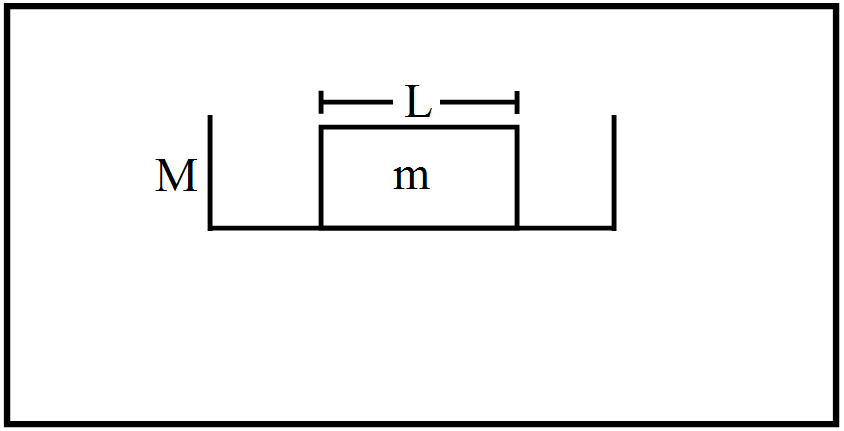
Consider a gravity-free hall in which a tray of mass M, carrying a cubical block of ice of mass m and edge L, is at rest in the middle. If the ice melts, by what distance does the centre of mass of "the tray plus the ice" system descend?

The length and the radius of a cylinder measured with a slide callipers are found to be 4.54cm and 1.75cm respectively. Calculate the volume of the cylinder.
A man, the surface area of whose skin is 2m2, is sitting in a room where area temperature is 20°C. If his skin temperature is 28°C and emissivity of his skin equals 0.97, find the rate at which his body loses heat $($Given $\sigma=5.67\times10^{-8}\text{w}/\ \text{m}^2/\ \text{T}^4).$
From a 20 m high tower, a bullet is fired from a gun in the horizontal direct. If $g=10 ms^{-2}$, and initial velocity of bullet is $400 ms^{-1}$ then at what distance will be bullet fall on the earth?
A car weighing 1400kg is moving at a speed of 54km/h up a hill when the motor stops. If it is just able to reach the destination which is at a height of 10m above the point, calculate the work done against friction (negative of the work done by the friction).
A point source is placed at a depth h below the surface of water (refractive index = μ).
  1. Show that light escapes through a circular area on the water surface with its centre directly above the point source.
  2. Find the angle subtended by a radius of the area on the source.
Find the average frictional force needed to stop a car weighing 500kg in a distance of 25m if the initial speed is 72km/ h.
Imagine what would happen if the value of G becomes:
  1. 100 times of its present value.
  2. Times of its present value.