Question
A relation R is defined as $R =\{(1,2)\}$ on set $A =$ $\{1,2,3\}$, then R is :

Answer

(C) - Transitive.
$\because(1,1),(2,2),(3,3) \notin R \Rightarrow R$ is not reflexive.
$\because(1,2) \in R$ but $(2,1) \notin R \Rightarrow R$ is not symmetric. $R$ is transitive because $(1,2) \notin R$ there is not any ordered pair starting from 2 .

Need a full question paper?

Generate a complete, print-ready paper with questions like this in minutes — across 16+ boards, with answer keys.
Start Generating Free

Similar questions

The solution of the differential equation,
$\text{x}^2\frac{\text{dy}}{\text{dx}}.\cos\frac{1}{\text{x}}-\text{y}\sin\frac{1}{\text{x}}=-1,$ where $\text{y}\rightarrow-1$ as $\text{x}\rightarrow-\infty,$ is:
  1. $\text{y}=\sin\frac{1}{\text{x}}-\cos\frac{1}{\text{x}}$
  2. $\text{y}=\frac{\text{x}+1}{\text{x}\sin\frac{1}{\text{x}}}$
  3. $\text{y}=\cos\frac{1}{\text{x}}+\sin\frac{1}{\text{x}}$
  4. $\text{y}=\frac{\text{x}+1}{\text{x}\cos\frac{1}{\text{x}}}$
Choose the correct option from given four options:
$\int\tan^{-1}\sqrt{\text{x}}\text{ dx}$ is equal to:
  1. $(\text{x}+1)\tan^{-1}\sqrt{\text{x}}-\sqrt{\text{x}}+\text{C}$
  2. $\text{x}\tan^{-1}\sqrt{\text{x}}-\sqrt{\text{x}}+\text{C}$
  3. $\sqrt{\text{x}}-\text{x}\tan^{-1}\sqrt{\text{x}}+\text{C}$
  4. $\sqrt{\text{x}}-(\text{x}+1)\tan^{-1}\sqrt{\text{x}}+\text{C}$
Evaluate $\begin{bmatrix}5&4&3\\3&4&1\\5&6&1\end{bmatrix}$is:
  1. 4
  2. -24
  3. -8
  4. 8
The area bounded by the lines y = |x – 2|, x = 1, x = 3 and the x- axis is:
  1. 1 sq. unit
  2. 2 sq. units
  3. 3 sq. units
  4. 4 sq. units
For which of the following values of mm, is the area of the region bounded by the curve $y = x - x^2$, and the line $y = mx$ equals $\frac{9}{2}\text{ sq. unit?}$
If ${ \sin }^{ -1 }\frac { \text{x} }{ 5 } +{ \text{cosec} }^{ -1 }\frac { 5 }{ 4 } $ then x is equal to:
  1. 1
  2. 4
  3. 3
  4. 5
find the coordinate of the tip of the position vector which is equivalent to $\overrightarrow{\text{AB}}$ where the coordinates of A and B are (-1, 3) and (-2, 1) respectively:
  1. (+1, +2)
  2. (+1, -2)
  3. (-1, +2)
  4. (-1, -2)
If $\text{A}=\begin{bmatrix}1&0&0\\0&1&0\\\text{a}&\text{b}&-1\end{bmatrix},$ then $A^2$ is equal to:
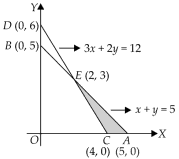
The maximum value of $Z=5 x+3 y$, if the shaded region represents the feasible region, is
Image
The function f(x) = [x], where [x] denotes the greatest integer function, is continuous at:
  1. 4
  2. -2
  3. 1
  4. 1.5