Question
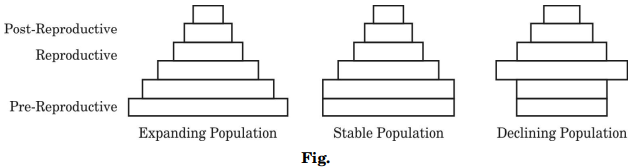
(a) Represent diagrammatically three kinds of age-pyramids for human populations.
(b) How does an age pyramid for human population at given point of time helps the policymakers in planning for future.
Answer

(a) A population at any given time is composed of individuals' ages. If the age distribution (per cent individuals of a given age or age group) is plotted for these population, the resulting structure is called an age pyramid.
Age distribution depends upon the natality and mortality and determines the population growth. With regard to age distribution, there are three kinds of population :
(1) Rapidly growing or expanding population :
It has high birth rate and low death rate, so there is more number of young individuals in the population. According to a recent survey, more than 36% of the Indian population consists of children below the age of 14 years, so the Indian population is called young population.
(2) Stationary or stable population : It has equal birth and death rates, so the population shows zero population growth.
(3) Declining population : It has higher death rate than birth rate, so the population of young members is lower than that of old members, e.g., Japan (ageing population).
Image
(b) The structure of the age pyramid helps to determine the growing status of the population and helps us to make an opinion saying if the population is groing or stablizing or declining.
On the basis of this information the government and policy makers would be able to form an informed conclusion on making policies for that particular kind of population.
The ideal population that is looked after by all the policy makers in order to build up a policy is a population pyramid in which the population of pre-reproductive population would show a stable and would not lead to either depletion of earthly resources or human resources.

Need a full question paper?

Generate a complete, print-ready paper with questions like this in minutes — across 16+ boards, with answer keys.

Start Generating Free

Similar questions