A resistor of $200 \Omega$ and a capacitor of $15.0 \mu F$ are connected in series to a $220 V , 50 Hz \ ac$ source. $(a)$ Calculate the current in the circuit; $(b)$ Calculate the voltage $\text{(rms)}$ across the resistor and the capacitor. Is the algebraic sum of these voltages more than the source voltage? If yes, resolve the paradox.
Example-(7.6)
Download our app for free and get started
Given
$R=200 \Omega, C=15.0 \mu F =15.0 \times 10^{-6} F$
$V=220 V , v=50 Hz$
$(a)$ In order to calculate the current, we need the impedance of the circuit. It is
$Z =\sqrt{R^2+X_C^2}=\sqrt{R^2+(2 \pi v C)^{-2}}$
$ =\sqrt{(200 \Omega)^2+\left(2 \times 3.14 \times 50 \times 15.0 \times 10^{-6} F \right)^{-2}}$
$ =\sqrt{(200 \Omega)^2+(212.3 \Omega)^2}$
$ =291.67 \Omega$
Therefore, the current in the circuit is
$I=\frac{V}{Z}=\frac{220 V }{291.5 \Omega}=0.755 A$
$(b)$ Since the current is the same throughout the circuit, we have
$V_R=I R=(0.755 A )(200 \Omega)=151 V$
$V_C=I X_C=(0.755 A )(212.3 \Omega)=160.3 V$
The algebraic sum of the two voltages, $V_R$ and $V_C$ is $311.3 V$ which is more than the source voltage of $220 V$.
How to resolve this paradox?
As you have learnt in the text, the two voltages are not in the same phase.
Therefore, they cannot be added like ordinary numbers.
The two voltages are out of phase by ninety degrees.
Therefore, the total of these voltages must be obtained using the Pythagorean theorem:
$V_{R+C} =\sqrt{V_R^2+V_C^2}$
$ =220 V$
Thus, if the phase difference between two voltages is properly taken into account, the total voltage across the resistor and the capacitor is equal to the voltage of the source.
$R=200 \Omega, C=15.0 \mu F =15.0 \times 10^{-6} F$
$V=220 V , v=50 Hz$
$(a)$ In order to calculate the current, we need the impedance of the circuit. It is
$Z =\sqrt{R^2+X_C^2}=\sqrt{R^2+(2 \pi v C)^{-2}}$
$ =\sqrt{(200 \Omega)^2+\left(2 \times 3.14 \times 50 \times 15.0 \times 10^{-6} F \right)^{-2}}$
$ =\sqrt{(200 \Omega)^2+(212.3 \Omega)^2}$
$ =291.67 \Omega$
Therefore, the current in the circuit is
$I=\frac{V}{Z}=\frac{220 V }{291.5 \Omega}=0.755 A$
$(b)$ Since the current is the same throughout the circuit, we have
$V_R=I R=(0.755 A )(200 \Omega)=151 V$
$V_C=I X_C=(0.755 A )(212.3 \Omega)=160.3 V$
The algebraic sum of the two voltages, $V_R$ and $V_C$ is $311.3 V$ which is more than the source voltage of $220 V$.
How to resolve this paradox?
As you have learnt in the text, the two voltages are not in the same phase.
Therefore, they cannot be added like ordinary numbers.
The two voltages are out of phase by ninety degrees.
Therefore, the total of these voltages must be obtained using the Pythagorean theorem:
$V_{R+C} =\sqrt{V_R^2+V_C^2}$
$ =220 V$
Thus, if the phase difference between two voltages is properly taken into account, the total voltage across the resistor and the capacitor is equal to the voltage of the source.

Download our appand get started for free
Experience the future of education. Simply download our apps or reach out to us for more information. Let's shape the future of learning together!No signup needed.*
Similar Questions
- 1View SolutionFind the time required for a 50Hz alternating current to change its value from zero to the rms value.
- 2View SolutionMention any three applications of the internet. Explain one of these in detail.
- 3View Solution
- When an AC source is connected to an ideal capacitor, show that the average power supplied by the source over a complete cycle is zero.
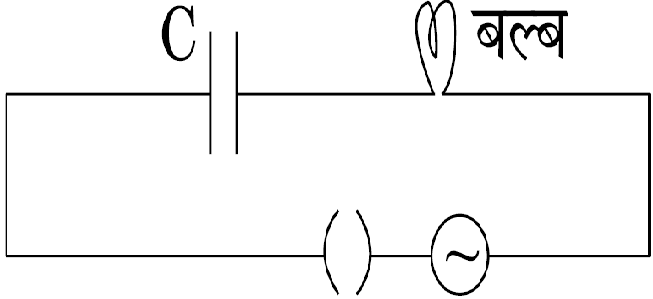
- A bulb is connected in series with a variable capacitor and an A.C. source as shown. What happens to the brightness of the bulb when the key is the capacitor is gradually reduced?
- 4Draw a circuit diagram of a common emitter amplifier using n-p-n transistor. Derive an expression for the current gain $\beta_{ac}.$View Solution
- 5The voltage and current in a series AC circuit are given by, $\text{V}=\text{V}_0\cos\omega\text{t}$ and $\text{i}=\text{i}_0\sin\omega\text{t}.$ What is the power dissipated in the circuit?View Solution
- 6View SolutionIn what way is Gauss’s law in magnetism different from that used in electrostatics? Explain briefly. The Earth’s magnetic field at the Equator is approximately 0.4 G. Estimate the Earth’s magnetic dipole moment. Given: Radius of the Earth = 6400 km.
- 7Two identical cells of emf 1.5 V each joined in parallel supply energy to an external circuit consisting of two resistances of 7 $\Omega$ each joined in parallel. A very high resistance voltmeter reads the terminal voltage of cells to be 1.4 V. Calculate the internal resistance of each cell.View Solution
- 8In a series LCR circuit connected to an ac source of variable frequency and voltage v $v_m= \sin, $ draw a plot showing the variation of current (I) with angular frequency ($\omega$) for two different values of resistance R1 and R2(R1 > R2 ). Write the condition under which the phenomenon of resonance occurs. For which value of the resistance out of the two curves, a sharper resonance is produced? Define Q-factor of the circuit and give its significance.View Solution
- 9View Solution
- Name the phenomenon on which the working of an optical fibre is based.
- What are the necessary conditions for this phenomenon to occur?
- Draw a labelled diagram of an optical fibre and show how light propagates through the optical fibre using this phenomenon.
- 10View SolutionCalculate the following:
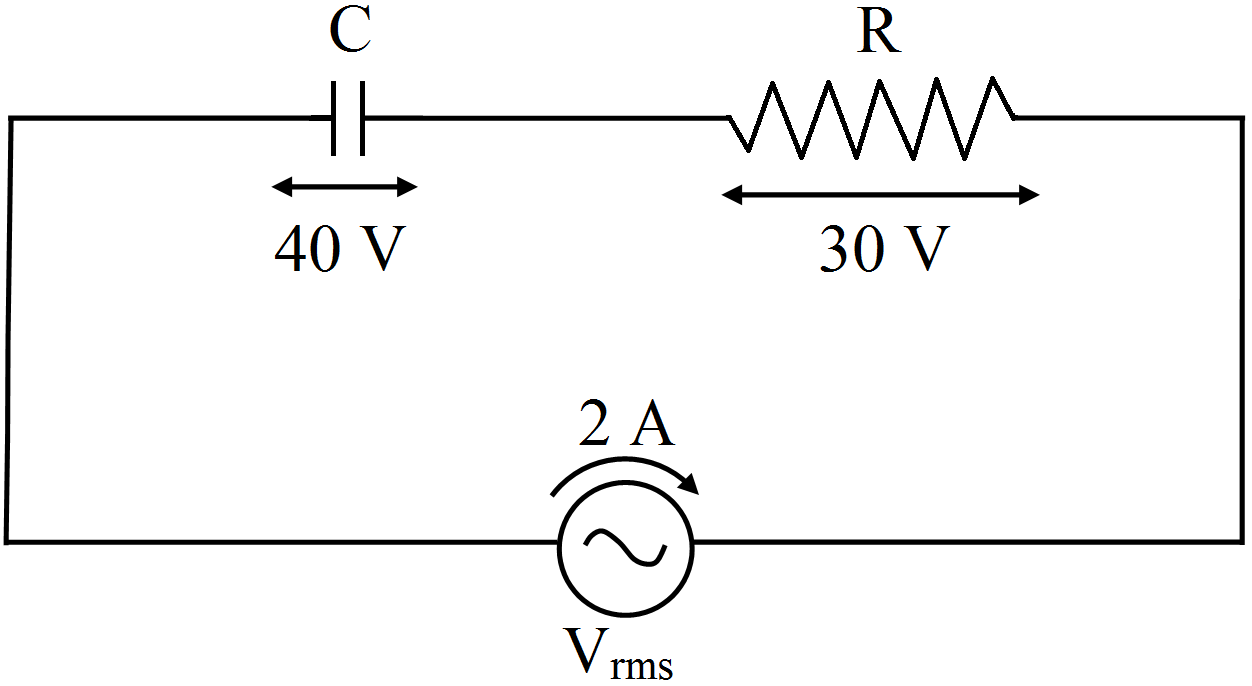
- Impedance of the given ac circuit.
- Wattless current of the given ac circuit.