MCQ
A reversible heat engine converts one-fourth of the heat input into work. When the temperature of the sink is reduced by $52\, K$, its efficiency is doubled. The temperature in Kelvin of the source will be ...... .
  • A
    $256$
  • $208$
  • C
    $104$
  • D
    $52$

Answer

Correct option: B.
$208$
b
$\eta=\frac{1}{4}=1-\frac{ T _{2}}{ T _{1}}$

$\frac{ T _{2}}{ T _{1}}=\frac{3}{4}$

$\frac{ T _{2}-52}{ T _{1}}=\frac{1}{2}$

Need a full question paper?

Generate a complete, print-ready paper with questions like this in minutes — across 16+ boards, with answer keys.

Start Generating Free

Similar questions

Four rods of indentical cross-sectional area and made from the same metal form the sides of a square. The temperature of two diagonally opposite points are $\theta$ and $\sqrt2 \theta$ respectively in the  teady state. Assuming that only heat conduction takes place, what will be the temperature difference between other two points ?
A $5\, kg$ collar is attached to a spring of spring constant $500\, Nm^{-1}$. It slides without friction over a horizontal rod. The collar is displaced from its equillibrium position by $10\, cm$ and released. The time period of oscillation is
In a cyclic process, work done by the system is
Which sample contains greater number of nuclei : a $5.00- \mu Ci$ sample of $_{240}Pu$ (half-life $6560\,y$) or a $4.45 - \mu Ci$ sample of $_{243}Am$ (half-life $7370\, y$)
The half life of $^{131}I$ is $8\, days$. Given a sample of $^{131}I$ at time $t = 0,$ we can assert that
Two tuning forks when sounded together produced $4$ beats/sec. The frequency of one fork is $256.$ The number of beats heard increases when the fork of frequency $256$ is loaded with wax. The frequency of the other fork is
Assertion : There exists two angles of incidence for the same magnitude of deviation (except minimum deviation) by a prism kept in air.

Reason : In a prism kept in air, a ray is incident on first surface and emerges out of second surface. Now if another ray is incident on second surface (of prism) along the previous emergent ray, then this ray emerges out of first surface along the previous incident ray. This particle is called principle of reversibility of light.
A weightless thread can support tension upto $30 \,N$. A stone of mass $0.5 \,kg$ is tied to it and is revolved in a circular path of radius $2 \,m$ in a vertical plane. If $g = 10m/{s^2}$, then the maximum angular velocity of the stone will be ........ $rad/s$
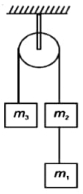
Three blocks of masses $m_1=4 \,kg , m_2=2 \,kg , m_3=4 \,kg$ are connected with ideal strings passing over a smooth. massless pulley as shown in figure. The acceleration of blocks will be ......... $m / s ^2$ $\left(g=10 \,m / s ^2\right)$
Two stones are thrown up simultaneously from the edge of a cliff $240\ m$ high with initial speed of $10\ m/s$ and $40\ m/s$ respectively. Which of the following graph best represents the time variation of relative position of the second stone with respect to the first ?

(Assume stones do not rebound after hitting the ground and neglect air resistance, take $g = 10\ m/ s^2$)
(The figures are schematic and not drawn to scale)