Question
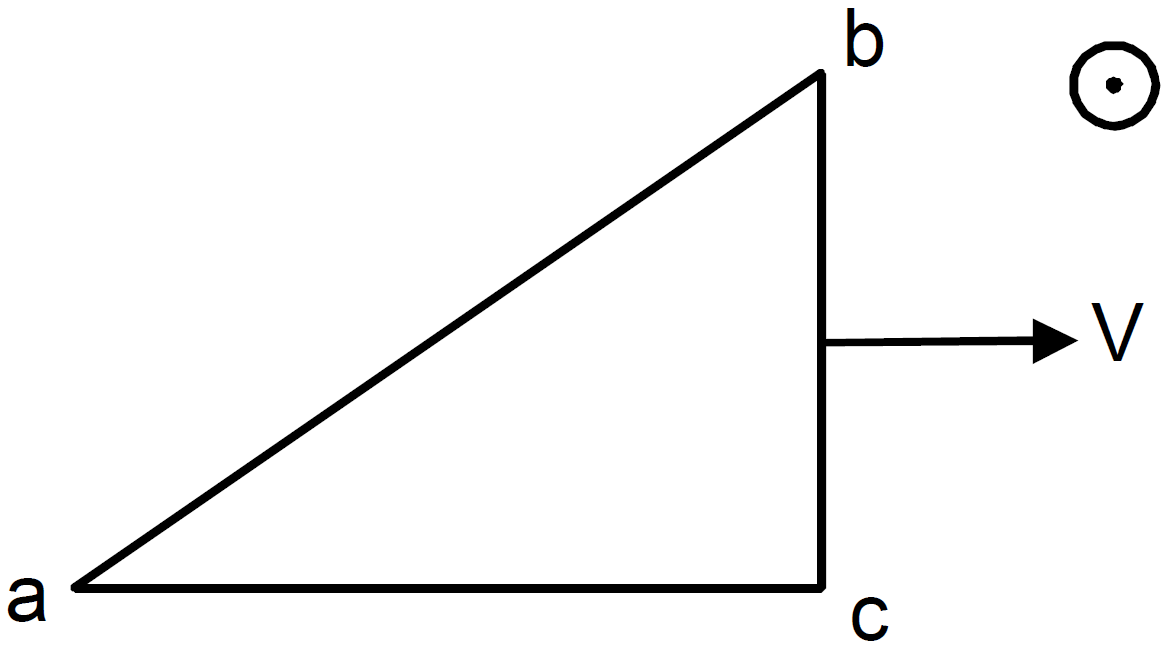
A right-angled triangle abc, made from a metallic wire, moves at a uniform speed v in its plane as shown in figure. A uniform magnetic field B exists in the perpendicular direction. Find the emf induced:
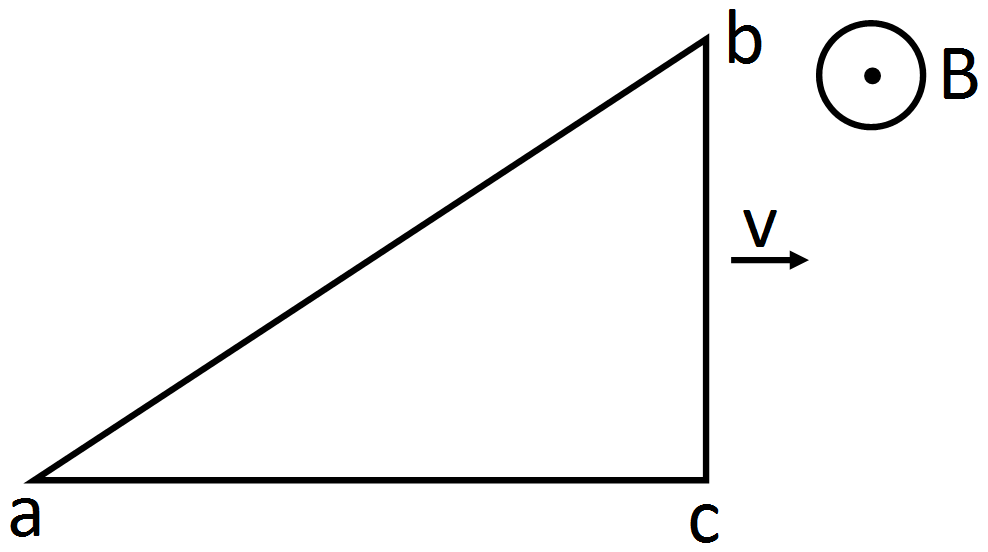
  1. In the loop abc.
  2. In the segment bc.
  3. In the segment ac.
  4. In the segment ab.

Answer


  1. Zero as the components of ab are exactly opposite to that of bc. So they cancel each other. Because velocity should be perpendicular to the length.
  2. e = Bv × l
= Bv(bc) + ve at C
  1. e = 0 as the velocity is not perpendicular to the length.
  2. e = Bv(bc) positive at ‘a’.
i.e. the component of ‘ab’ along the perpendicular direction.

Need a full question paper?

Generate a complete, print-ready paper with questions like this in minutes — across 16+ boards, with answer keys.

Start Generating Free

Similar questions

A $100\mu\text{F}$ capacitor is joined to a 24V battery through a $1.0\text{M}\Omega$ resistor. Plot qualitative graphs (a) between current and time for the first 10 minutes and (b) between charge and time for the same period.
The initial pressure and volume of a given mass of a gas $\Big(\frac{\text{C}_\text{P}}{\text{C}_\text{V}}=\gamma\Big)$ are $P_0$ and $V_0$. The gas can exchange heat with the surrounding.
  1. It is slowly compressed to a volume $\frac{\text{V}_0}{2}$ and then suddenly compressed to $\frac{\text{V}_0}{4}.$ Find the final pressure.
  2. If the gas is suddenly compressed from the volume $V_0$ to $\frac{\text{V}_0}{2}$ and then slowly compressed to $\frac{\text{V}_0}{4},$ what will be the final pressure?
Let us list some of the factors, which could possibly influence the speed of wave propagation:
  1. Nature of the source.
  2. Direction of propagation.
  3. Motion of the source and/or observer.
  4. Wavelength.
  5. Intensity of the wave.
On which of these factors, if any, does
  1. The speed of light in vacuum,
  2. The speed of light in a medium (say, glass or water), depend?
A regular polygon of n sides is formed by bending a wire of total length $27\pi\text{r}$ which carries a current i.
  1. Find the magnetic field B at the centre of the polygon.
  2. By letting $\text{n}\rightarrow\infty,$ deduce the expression for the magnetic field at the centre of a circular current.
$4 \times 10^{23}$ tritium atoms are contained in a vessel. The half-life of decay tritium nuclei is 12.3y. Find:
  1. The activity of the sample.
  2. The number of decay in the next 10 hours.
  3. The number of decays in the next 6.15y.
An air-filled parallel-plate capacitor is to be constructed which can store $12\mu\text{C}$ of charge when operated at 1200V. What can be the minimum plate area of the capacitor? The dielectric strength of air is $3 \times 10^6Vm^{-1}.$
A biconvex thick lens is constructed with glass $(\mu=1.50)$ Each of the surfaces has a radius of 10cm and the thickness at the middle is 5cm. Locate the image of an object placed far away from the lens.
A myopic adult has a far point at 0.1m. His power of accomodation is 4 diopters.
  1. What power lenses are required to see distant objects?
  2. What is his near point without glasses?
  3. What is his near point with glasses? (Take the image distance from the lens of the eye to the retina to be 2cm.)
A rectangular metallic loop of length l and width b is placed coplanarly with a long wire carrying a current i. The loop is moved perpendicular to the wire with a speed v in the plane containing the wire and the loop. Calculate the emf induced in the loop when the rear end of the loop is at a distance a from the wire. Solve by using Faraday's law for the flux through the loop and also by replacing different segments with equivalent batteries.
In the Auger process an atom makes a transition to a lower state without emitting a photon. The excess energy is transferred to an outer electron which may be ejected by the atom. (This is called an Auger electron). Assuming the nucleus to be massive, calculate the kinetic energy of an n = 4 Auger electron emitted by Chromium by absorbing the energy from a n = 2 to n = 1 transition.