Question
A right angled triangle whose sides are $3\ cm, 4\ cm$ and $5\ cm$ is revolved about the sides containing the right angle in two ways. Find the difference in volumes of the two cones so formed. Also, find their curved surfaces.
Answer

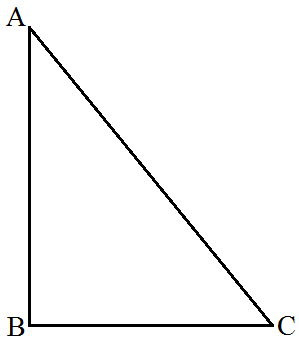
We consider the following figure as follows

Let the angle B is right angle and the sides of the triangle are $AB = 4cm, BC = 3cm,$
AC = 5cm.
When the triangle is revolved about the side $AB$, then the base-radius, height and slant height of the produced cone becomes $BC, AB$ and $AC$ respectively. Therefore, the volume of the produced cone is
$\text{V}_1=\frac{1}{3}\pi\times\text{BC}^2\times\text{AB}$
$=\frac{1}{3}\pi\times(3)^2\times4$
$=12\pi$ cubic cm
In this case, the curved surface area of the cone is
$\text{S}_1=\pi\times\text{BC}\times\text{AC}$
$=\pi\times3\times5$
$=15\pi$ square cm
When the triangle is revolved about the side $BC$, then the base-radius, height and slant height of the produced cone becomes $AB, BC$ and $AC$ respectively. Therefore, the volume of the produced cone is
$\text{V}_2=\frac{1}{3}\pi\times\text{AB}^2\times\text{BC}$
$=\frac{1}{3}\pi\times(4)^2\times3$
$=16\pi$ cubic cm

Need a full question paper?

Generate a complete, print-ready paper with questions like this in minutes — across 16+ boards, with answer keys.
Start Generating Free

Similar questions

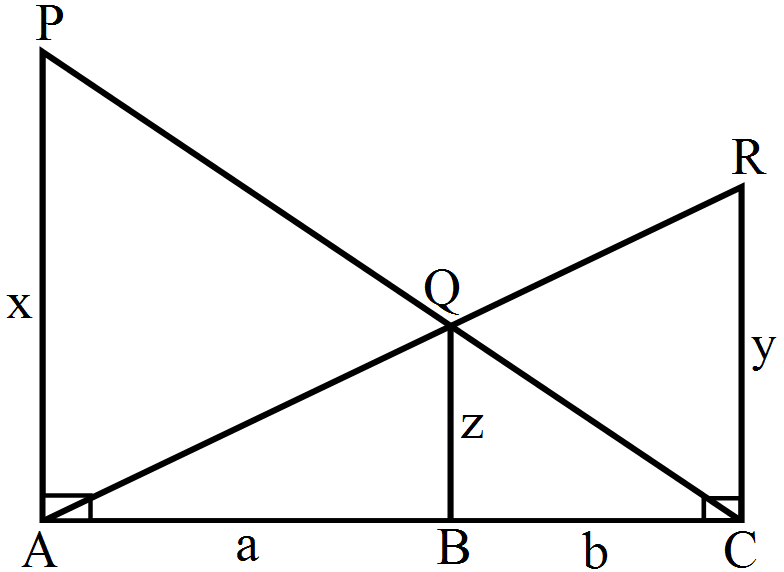
In the given figure, each one of $P A, Q B$ and $R C$ is perpendicular to $A C$. If $A P=x, Q B=z, R C=y, A B=a$ and $B C=b$, show that $\frac{1}{x}+\frac{1}{y}=\frac{1}{z}$.
Solve for $x$ and $y:$
$\frac{35}{\text{x}+\text{y}}+\frac{14}{\text{x}-\text{y}}=19,$ $\frac{14}{\text{x}+\text{y}}+\frac{35}{\text{x}-\text{y}}=37$
Solve the following system of equations graphically:
$3x + y + 1 = 0,$
$2x - 3y + 8 = 0$
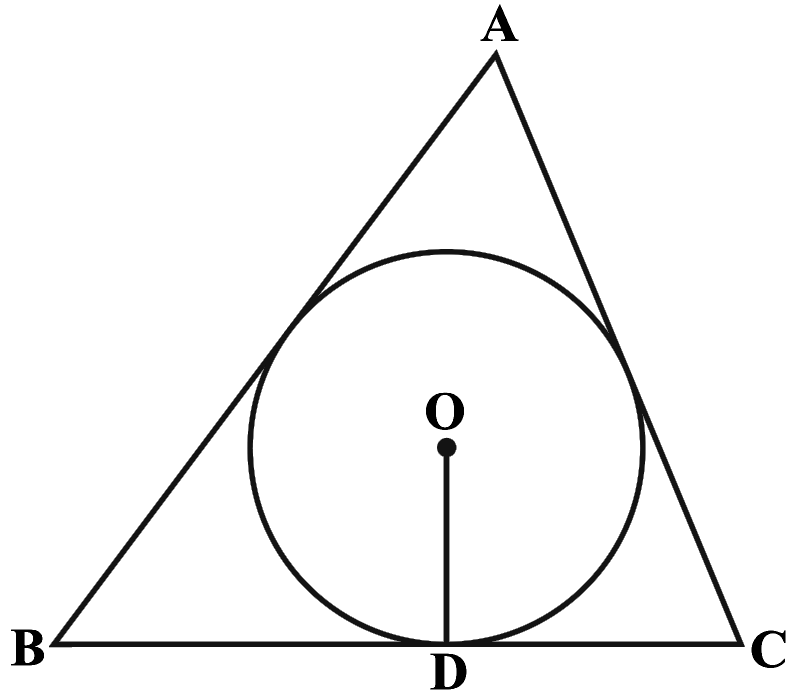
QUESIION In the given figure, a triangle $A B C$ is drawn to circumscribe a circle of radius $2 \ cm$ such that the segments $B D$ and $D C$ into which $B C$ is divided by the point of contact $D$, are of lengths $4 \ cm$ and $3 \ cm$ respectively. If the area of $\triangle A B C=21 cm^2$ then find the lengths of sides of $A B$ and $A C$.
If $\sin\theta=\frac{3}{4},$ show that $\sqrt{\frac{\text{cosec}^2\theta-\cot^2\theta}{\sec^2\theta-1}}=\frac{\sqrt{7}}{3}.$
Solve the following systems of equations:
$\frac{2}{\sqrt{\text{x}}}+\frac{3}{\sqrt{\text{y}}}=2,$
$\frac{4}{\sqrt{\text{x}}}-\frac{9}{\sqrt{\text{y}}}=-1.$
An open metal bucket is in the shape of a frustum of a cone, mounted on a hollow cylindrical base made of the same metallic sheet. The diameters of the two circular ends of the bucket are $45\ cm$ and $25\ cm,$ the total vertical height of the bucket is $40\ cm$ and that of the cylindrical base is $6\ cm$. Find the area of the metallic sheet used to make the bucket. Also, find the volume of water the bucket can hold, in litres.
Six bells commence tolling together and toll at intervals of $2, 4, 6, 8, 10, 12$ minutes respectively. In $30$ hours, how many times do they toll together?
Find the mean, mode and median of the following frequency distribution.
Class
$0-10$
$10-20$
$20-30$
$30-40$
$40-50$
$50-60$
$60-70$
Frequency
$4$
$4$
$7$
$10$
$12$
$8$
$5$
Two water taps together can fill a tank in $6$ hours. The tap of larger diameter takes $9$ hours less than the smaller one to fill the tank separately. Find the time in which each tap can separately fill the tank.