Question
A right circular cylinder and aright circular cone have equal bases and equal heights. If their curved surfaces are in the ratio 8 : 5, determine the ratio of the radius of the base to the height of either of them.

Answer

Let r and h be the radius and height of a cylinder and a cone respectively
$\therefore$ Slant height of cone $=\sqrt{\text{r}^2+\text{h}^2}$
Now curved surface area of cylinder $=2\pi\text{rh}$
and cureved surface area of cone $=\pi\text{rl}$
$=\pi\text{r}\sqrt{\text{r}^2+\text{h}^2}$
$\because$ their ratio is 8 : 5
$\therefore\frac{2\pi\text{rh}}{\pi\text{r}\sqrt{r^2+\text{h}^2}}=\frac{8}{5}\Rightarrow\frac{2\text{h}}{\sqrt{r^2+\text{h}^2}}=\frac{8}{5}$
$\Rightarrow\frac{4\text{h}^2}{\text{r}^2+\text{h}^2}=\frac{64}{25}$ (squaring both side)
$\Rightarrow\frac{\text{h}^2}{\text{r}^2+\text{h}^2}=\frac{16}{25}$ (Dividing by 4)
$\Rightarrow25\text{h}^2=16\text{r}^2+16\text{h}^2$
$\Rightarrow25\text{h}^2-16\text{h}^2=16\text{r}^2\Rightarrow9\text{h}^2=16\text{r}^2$
$\Rightarrow\frac{\text{r}^2}{\text{h}^2}=\frac{9}{16}\Rightarrow\Big(\frac{\text{r}}{\text{h}}\Big)^2=\Big(\frac{3}{4}\Big)^2$
$\therefore\frac{\text{r}}{\text{h}}=\frac{3}{4}\Rightarrow\text{r}:\text{h}=3:4$
$\therefore$ Ratio of r and h = 3 : 4

Need a full question paper?

Generate a complete, print-ready paper with questions like this in minutes — across 16+ boards, with answer keys.
Start Generating Free

Similar questions

A wire is bent to form a square enclosing an area of $484m^2$​​​​​​​. Using the same wire, a circle is formed. Find the area of the circle.
Solve the following systems of equations:
$\sqrt{2}\text{x}-\sqrt{3}\text{y}=0,$
$\sqrt{3}\text{x}-\sqrt{8}\text{y}=0.$
A train travels $180\ km$ at a uniform speed. If the speed had been 9km/hr more, it would have taken $1$ hour less for the same journey. Find the speed of the train.
ABCD is a cyclic quadrilateral such that $\angle\text{A}=(4\text{y}+20)^\circ,\angle\text{B}=(3\text{y}-5)^\circ$ $\angle\text{C}=(-4\text{x})^\circ$ and $\angle\text{D}=(7\text{x}+5)^\circ$ Find the four angles.
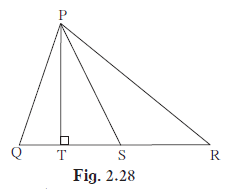
In the figure 2.28 seg PS is the median of ΔPQR and PT ⊥ QR. Prove that,
(1) $PR ^2= PS ^2+ QR \times ST +\left(\frac{ QR }{2}\right)^2$
(2) $PQ ^2= PS ^2- QR \times ST +\left(\frac{ QR }{2}\right)^2$
Solve the following quadratic equations by factorization:
$\frac{2\text{x}}{\text{x}-4}+\frac{2\text{x}-5}{\text{x}-3}=\frac{25}{3}$
It is given that $-1$ is one of the zeros of the polynomial $x^3 + 2x^2 - 11x - 12$. Find all the given zeros of the given polynomial.
If $p^{\text {th }}, q^{\text {th }}$ and $r^{\text {th }}$ terms of an A. P. are $l, m, n$ respectively, show that
$(q-r) l+(r-p) m+(p-q) n=0$
Mr.Jitendra invested an equal amount in two companies by purchasing equity shares with market price Rs. 160 and Rs.175 each. At the end of the year, both the companies declared the dividend of 15% and 20% each. In which company was her investment profitable?
Disha purchased an A.C. Unit from a dealer. The printed price of an A.C. unit is ₹ 45,000 . Dealer offered a discount of 15 % on it. The rate of GST on it is 14 %. Then at what price A.C. unit was sold to Disha by dealer? Find CGST and SGST amount printed on tax invoice.