A rigid bar of mass $15\ kg$ is supported symmetrically by three wire each of $2 m$ long. These at each end are of copper and middle one is of steel. Young's modulus of elasticity for copper and steel are $110 \times 10^9 N / m ^2$ and $190 \times 10^9 N / m ^2$ respectively. If each wire is to have same tension, ratio of their diameters will be $............$
Medium
Download our app for free and get started
Tension is same $($given$)$
From free body diagram
$3 T=150 N$
$T=50 N$
Since the bar has to be supported symmetrically Therefore extension in each wire will be same
We know $\Delta x=\frac{F L}{A Y}$
Compare $1$ copper wire with another steel wire
$\frac{F L}{A_C Y_C}=\frac{F L}{A_S Y_S}$
$\Rightarrow \frac{A_S}{A_C}=\frac{Y_C}{Y_S}$ $\left\{\begin{array}{l}\text { Where, } \\ A_C-\text { Area of copper wire } \\ Y_C-\text { Young's modulus copper } \\ A_S-\text { Area of steel wire } \\ Y_S-\text { Young's modulus steel }\end{array}\right.$
Substitutuing value of $Y_C$ and $Y_s$
$\frac{\pi d_S^2}{4 \times \frac{\pi}{4} \times d_C^2}=\frac{110 \times 10^9}{190 \times 10^9}$
$\frac{d_S}{d_C}=\sqrt{\frac{11}{19}}$ $\left\{\begin{array}{l}d_S \text {-diameter of steel wire } \\ d_C \text {-diameter of copper wire }\end{array}\right.$
$\frac{d_C}{d_S}=\sqrt{\frac{19}{11}}$
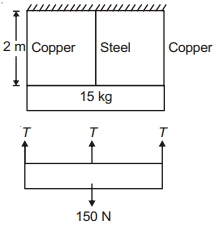
From free body diagram
$3 T=150 N$
$T=50 N$
Since the bar has to be supported symmetrically Therefore extension in each wire will be same
We know $\Delta x=\frac{F L}{A Y}$
Compare $1$ copper wire with another steel wire
$\frac{F L}{A_C Y_C}=\frac{F L}{A_S Y_S}$
$\Rightarrow \frac{A_S}{A_C}=\frac{Y_C}{Y_S}$ $\left\{\begin{array}{l}\text { Where, } \\ A_C-\text { Area of copper wire } \\ Y_C-\text { Young's modulus copper } \\ A_S-\text { Area of steel wire } \\ Y_S-\text { Young's modulus steel }\end{array}\right.$
Substitutuing value of $Y_C$ and $Y_s$
$\frac{\pi d_S^2}{4 \times \frac{\pi}{4} \times d_C^2}=\frac{110 \times 10^9}{190 \times 10^9}$
$\frac{d_S}{d_C}=\sqrt{\frac{11}{19}}$ $\left\{\begin{array}{l}d_S \text {-diameter of steel wire } \\ d_C \text {-diameter of copper wire }\end{array}\right.$
$\frac{d_C}{d_S}=\sqrt{\frac{19}{11}}$

Download our appand get started for free
Experience the future of education. Simply download our apps or reach out to us for more information. Let's shape the future of learning together!No signup needed.*
Similar Questions
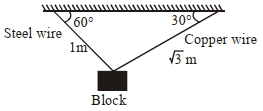
- 1A block of weight $100 N$ is suspended by copper and steel wires of same cross sectional area $0.5 cm ^2$ and, length $\sqrt{3} m$ and $1 m$, respectively. Their other ends are fixed on a ceiling as shown in figure. The angles subtended by copper and steel wires with ceiling are $30^{\circ}$ and $60^{\circ}$, respectively. If elongation in copper wire is $\left(\Delta \ell_{ C }\right)$ and elongation in steel wire is $\left(\Delta \ell_{ s }\right)$, then the ratio $\frac{\Delta \ell_{ C }}{\Delta \ell_{ S }}$ is. . . . . .View Solution
[Young's modulus for copper and steel are $1 \times 10^{11} N / m ^2$ and $2 \times 10^{11} N / m ^2$ respectively]
- 2A uniform cubical block is subjected to volumetric compression, which decreases its each side by $2 \%$. The Bulk strain produced in it is ............View Solution
- 3The Young's modulus of a wire of length $L$ and radius $r$ is $Y$. If the length is reduced to $\frac{L}{2}$ and radius is $\frac{r}{2}$ , then the Young's modulus will beView Solution
- 4A steel wire of length ' $L$ ' at $40^{\circ}\,C$ is suspended from the ceiling and then a mass ' $m$ ' is hung from its free end. The wire is cooled down from $40^{\circ}\,C$ to $30^{\circ}\,C$ to regain its original length ' $L$ '. The coefficient of linear thermal expansion of the steel is $10^{-5} { }^{\circ}\,C$, Young's modulus of steel is $10^{11}\, N /$ $m ^2$ and radius of the wire is $1\, mm$. Assume that $L \gg $ diameter of the wire. Then the value of ' $m$ ' in $kg$ is nearlyView Solution
- 5A boy’s catapult is made of rubber cord which is $42\, cm$ long, with $6\, mm$ diameter of cross -section and of negligible mass. The boy keeps a stone weighing $0.02\, kg$ on it and stretches the cord by $20\, cm$ by applying a constant force. When released, the stone flies off with a velocity of $20\, ms^{-1}$. Neglect the change in the area of cross section of the cord while stretched. The Young’s modulus of rubber is closest toView Solution
- 6Young's modulus is determined by the equation given by $\mathrm{Y}=49000 \frac{\mathrm{m}}{\ell} \frac{\text { dyne }}{\mathrm{cm}^2}$ where $\mathrm{M}$ is the mass and $\ell$ is the extension of wre used in the experiment. Now error in Young modules $(\mathrm{Y})$ is estimated by taking data from $M-\ell$ plot in graph paper. The smallest scale divisions are $5 \mathrm{~g}$ and $0.02$ $\mathrm{cm}$ along load axis and extension axis respectively. If the value of $M$ and $\ell$ are $500 \mathrm{~g}$ and $2 \mathrm{~cm}$ respectively then percentage error of $\mathrm{Y}$ is :View Solution
- 7View SolutionThe elastic limit for a gas
- 8A $2 \,m$ long rod of radius $1 \,cm$ which is fixed from one end is given a twist of $0.8$ radians. The shear strain developed will beView Solution
- 9The mean distance between the atoms of iron is $3 \times {10^{ - 10}}m$ and interatomic force constant for iron is $7\,N\,/m$The Young’s modulus of elasticity for iron isView Solution
- 10Two wires of equal lengths are made of the same material. Wire $A$ has a diameter that is twice as that of wire $B$. If identical weights are suspended from the ends of these wires, the increase in length isView Solution